Visual Schedules for Autistic Kids: When They Help and How to Actually Use Them
This article may contain affiliate links. Learn more
Every autism parent eventually hears about visual schedules. A therapist mentions them, a teacher has one on the wall, and a stranger in an online group swears by hers. So you print something, tape it up, and wait for the calm to descend.
And sometimes it does. Other times your child looks at it, looks at you, and walks away. Or worse, it becomes one more thing to argue about.
Visual schedules are useful, but they're a tool, not a spell. Here's what they're actually for and how to get one working.
Why they help
Spoken words disappear the moment they're said. A picture stays put. For a lot of autistic kids, that difference matters.
A visual schedule shows what's happening and in what order, so your child doesn't have to hold it in their head or decode it from a stream of instructions. That can help with several common trouble spots:
- Transitions. Moving from one activity to another is hard for many kids, especially when the switch feels sudden. A schedule turns "surprise" into "expected."
- Anxiety about what's next. Not knowing is stressful. Knowing, even when the answer is "brush teeth," is easier.
- Multi-step routines. Getting ready in the morning is a dozen steps. A visual breaks it into pieces.
- Reducing nagging. When the schedule says it's time for shoes, the schedule is the boss, not you. Many parents find that's a relief for everyone.
When they help less
Visual schedules aren't magic, and they can flop for predictable reasons:
- The format doesn't match the child. Some kids do best with real photos, others with simple line drawings, others with written words. Too abstract, and it means nothing. Too cluttered, and it's noise.
- It's too big too soon. A full-day schedule can overwhelm a child who's never used one.
- It's used as a threat. If the schedule only shows up when something unpleasant is coming, your child will learn to distrust it.
- It never changes. Life changes. If the schedule can't handle a surprise, it can make surprises worse.
Things parents can try
Start small. Pick one routine that's a daily struggle, such as getting dressed or bedtime, and build a short sequence for just that. Three to five steps is plenty.
Match the symbols to your child. Try photos of your own bathroom, your own shoes, your own table. Familiar images are often easier to understand than generic clip art. If your child reads, words may work fine.
Make it physical and interactive. Many kids like moving a card to a "done" pocket or flipping it over. That small action gives a clear signal that a step is finished and gives your child a job to do.
Put it where the activity happens. A bathroom sequence belongs in the bathroom. A morning routine belongs near the bedroom or the front door.
Add something to look forward to. Ending a schedule with a preferred activity gives the sequence a payoff. It works best when it's an honest "first this, then that," not a bribe you'll walk back.


Build in a "surprise" card. A simple card that means "something different is happening" can help kids get used to change without falling apart. Introduce it during low-stress moments first.
Teach it, don't just post it. Walk through it with your child a few times. Point to the picture, do the step, and move the card together. Then pull back your help gradually as they get the idea.
Use it consistently. If the schedule only works at home and school ignores it, or vice versa, progress slows. Share it with teachers and therapists so everyone uses the same system.
When a structured resource may help
Making visual schedules from scratch is doable, but it's also a time sink. You need pictures, printing, laminating, Velcro, and a system for organizing it all. Then you need to make new ones every time a new routine comes up.
A ready-made set may help if:
- You want a variety of schedules without designing each one yourself
- You're not sure which routines to start with
- You'd like consistent visuals that can be used across home and school
- You've tried making your own and the effort keeps stalling out
The value of a good set isn't just the pictures. It's having the work done so you can spend your energy teaching your child to use the schedule.
A resource worth a look
Full disclosure: Autisable is an affiliate partner of Special Learning. If you buy through the link below, we may earn a commission at no extra cost to you. We only mention resources we think fit the topic.
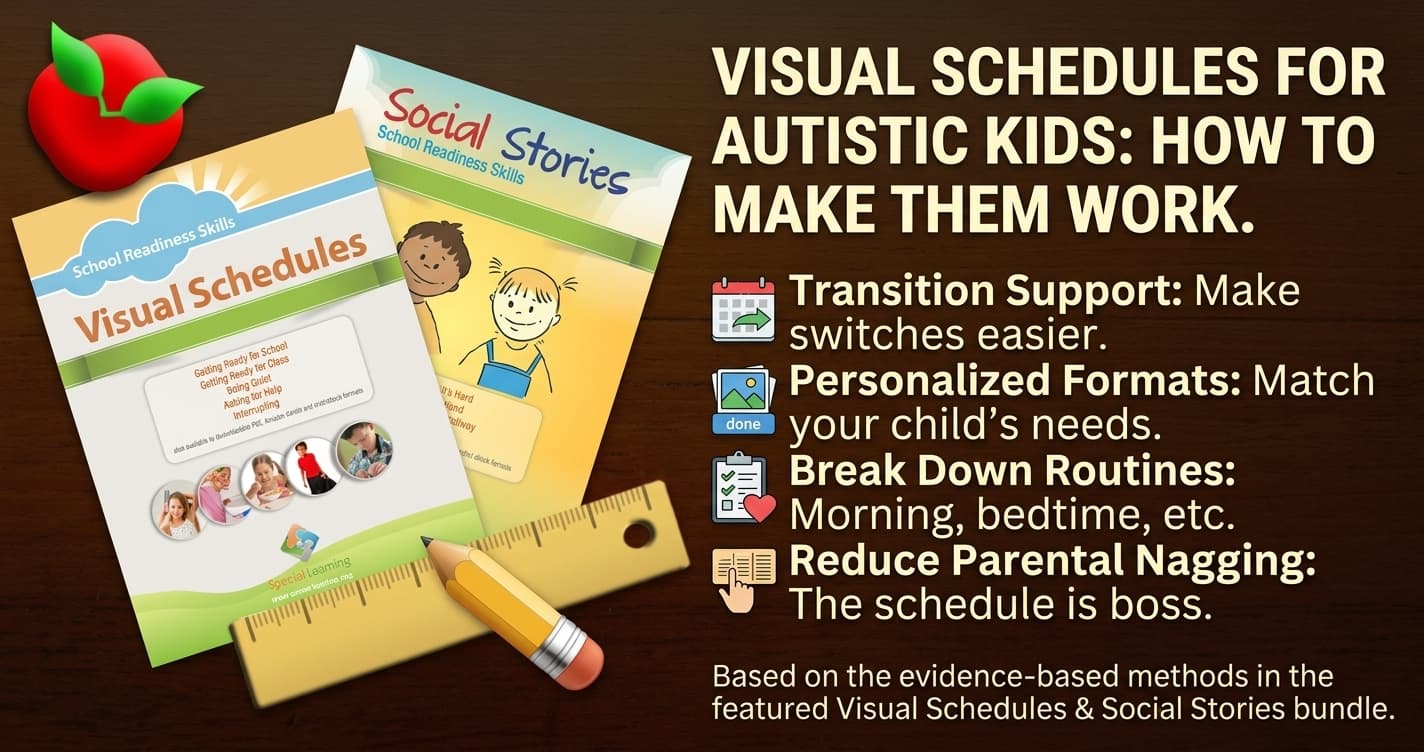
Special Learning offers the Building Basic Social Skills and Visual Schedule Curriculum Bundle ($59.99), a downloadable kit that pairs visual schedules, such as Getting Ready for School and Asking for Help, with social stories. It's digital only, so you'll print and assemble it yourself. If you'd rather start with a ready-made set than build one card at a time, it's worth a look.
The short version
Visual schedules work best when they're small, familiar, and actually used. Start with one routine, match the format to your child, teach it rather than just posting it, and keep it consistent across settings. If making them yourself is what's holding you back, a ready-made set can get you going faster.



Disclosure: Autisable.com participates in affiliate programs, including the Amazon Services LLC Associates Program and other affiliate advertising programs. This means we may earn commissions from qualifying purchases at no additional cost to you.
Comments
Join the community to leave a comment.