Teaching Hygiene and Personal Care to an Autistic Teen: Start Smaller Than You Think
This article may contain affiliate links. Learn more
Ask a parent what they mean by "hygiene skills" and you'll get a cheerful answer: brush your teeth, wash your hands, take a shower. Three tasks, done in a few minutes.
Now watch a young person try to do one of them. Brushing teeth alone involves picking up the brush, wetting it, applying toothpaste, tolerating the taste and the foam, moving the brush around every surface, spitting, rinsing, and putting everything away. That's ten or more steps, and a mouth full of sensory information at the same time.
So when an autistic child or teen resists, forgets steps, or does a quick pass and calls it done, it's often not stubbornness. The task is bigger than it looks.
Why personal care can be hard
A few things tend to be at play:


- Sensory sensitivity. Water temperature, the sound of a running shower, the texture of a washcloth, the taste of toothpaste, or the feel of wet hair can all be uncomfortable or overwhelming.
- Many steps in a sequence. Missing or mixing up one step can derail the whole routine.
- Unclear purpose. If a person can't see the point of doing something, it can feel arbitrary. "Wash your hair" doesn't explain much.
- Hard-to-see results. Clean hands look like dirty hands. Without a clear signal, it's hard to know when the job is done.
- Motor planning. Coordinating both hands and body through a sequence can be genuinely difficult.
- Transitions. Stopping a preferred activity to go do a chore is hard for a lot of kids.
Start smaller than you think
The most useful idea in teaching daily living skills is to break a task into small steps and teach one at a time. Professionals call this task analysis. You don't need the jargon, just the habit.
Write out every step of the routine, in the order it happens, as if you were explaining it to someone who's never done it. Then decide where your child is right now. Which steps can they do? Which need help?
Then pick one step to focus on. Only one.
Some families teach the last step first (this is called backward chaining). You do everything except the final step, then let your child complete it and celebrate. Once that step is solid, you back up one more. The child always finishes the task, which builds confidence and gives the effort a clear ending.
Things parents can try
Look at the sensory side first. Try different toothpaste flavors or unflavored options, a softer or electric toothbrush, a different water temperature, a handheld showerhead, or a soft cloth. Sometimes solving the discomfort solves the "behavior."
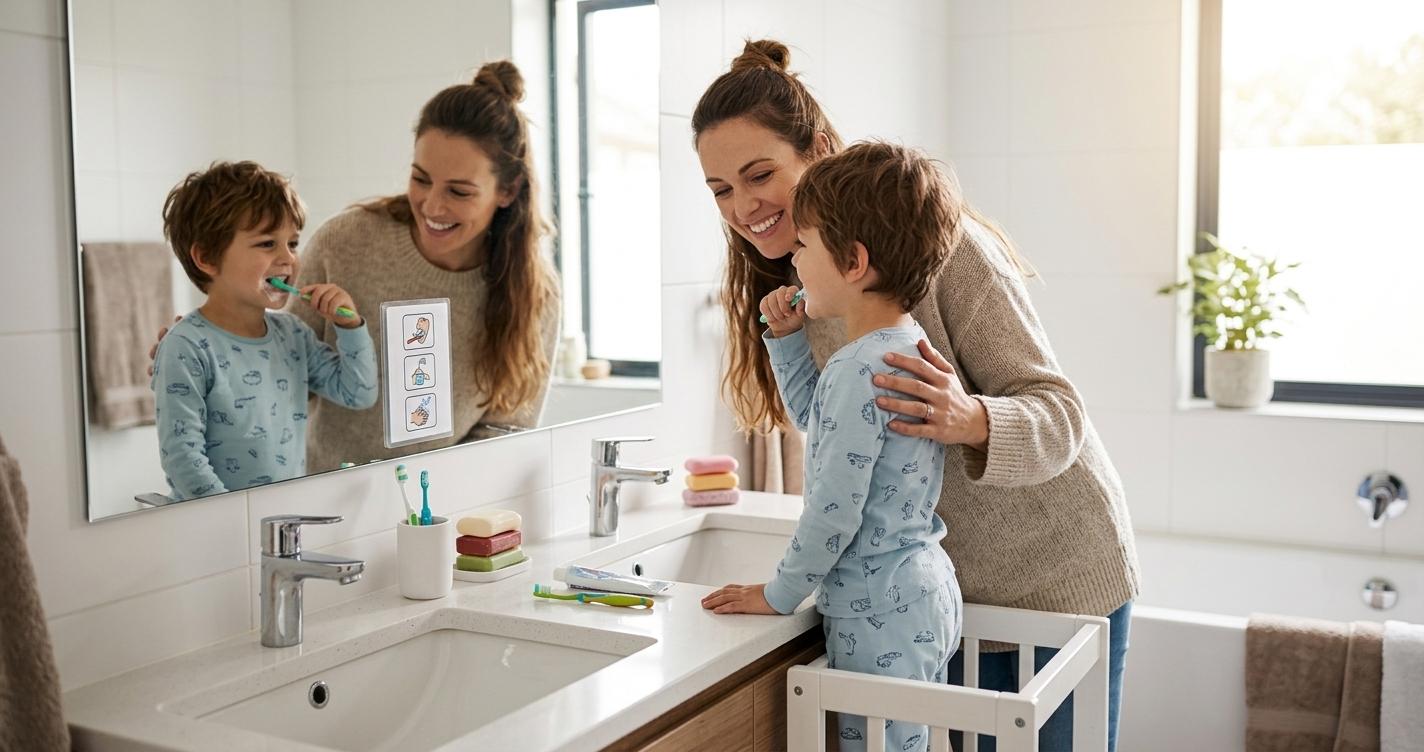
Show the steps with pictures. A short sequence taped in the bathroom, with one picture per step, takes the load off memory and language.
Do it together at first. Sit or stand alongside your child and model each step. Then gradually do less and let them do more.
Use hand-over-hand sparingly. Physically guiding a child can help with new motor skills, but it can also feel intrusive. Try modeling, pointing, or a picture cue first, and go back to physical help only when needed.
Make the result visible. A timer for brushing, a song that lasts two minutes, or a fun soap that changes color can show when a step is finished.
Give a reason that makes sense. Some kids respond to a concrete reason ("your teeth stay strong") more than a vague one ("it's good for you").
Keep the routine consistent. Same order, same place, same time of day. Predictability lowers the effort of every step.
Respect privacy and dignity. As kids get older, think about what support is appropriate and how much independence you can hand over. Shift from hands-on help to reminders to checklists as they're ready.
Celebrate small wins. A step completed without help is worth noticing, even when the rest still needs support.
Be patient with the timeline. Independence with a routine can take months or years, and skills sometimes slip when life changes. That's normal.
When a structured resource may help
Some skills, like teen hygiene, deodorant, shaving, or managing a period, involve a lot more steps and more sensitive territory. Parents often find themselves unsure how to teach them or worried about getting it wrong. A structured curriculum may help if:
- You want a clear breakdown of steps for many different self-care tasks
- You're teaching a pre-teen, teen, or young adult and want age-appropriate materials
- You'd like teaching strategies you can use across multiple routines
- You're working with school or therapy staff and want a shared approach
It doesn't replace your child's own timeline, but it can give you a framework and save you from writing every task analysis yourself.
A resource worth a look
Full disclosure: Autisable is an affiliate partner of Special Learning. If you buy through the link below, we may earn a commission at no extra cost to you. We only mention resources we think fit the topic.
Special Learning offers the Personal Care and Hygiene Curriculum ($199), a downloadable set that includes a workbook and detailed lesson plans. It provides task analyses, step-by-step guides, practice activities, and a coaching section with discussion topics, and it is written with older kids, teens, and young adults in mind. At $199 it's the biggest investment among the resources we've covered, so it makes the most sense if you're teaching several routines and want a full framework, rather than working on a single skill.
The short version
Personal care routines are bigger than they look, and sensory issues are often part of the picture. Break each routine into steps, teach one step at a time, use pictures and consistent routines, and adjust the sensory details before assuming it's a behavior problem. Expect the process to take time. If you'd like a full curriculum to work from, a structured resource can help.



Disclosure: Autisable.com participates in affiliate programs, including the Amazon Services LLC Associates Program and other affiliate advertising programs. This means we may earn commissions from qualifying purchases at no additional cost to you.
Comments
Join the community to leave a comment.