What’s the most interesting difference between Indian autism and American autism?I think it’s the way parents and others perceive it.
Indian and American scientists both lament the low level of scientific understanding in their respective countries.What’s interesting is how that affects people’s interpretation of autism.
In American we have a secular culture of blame.“Someone did me wrong” is an all-pervasive theme in our culture.We interpret everything from the behavior of other countries to the conduct of ex-spouses through that lens.
When it comes to “interpreting autism,” that thinking has spawned toxic notions like, “mercury poisoned my kid,” “vaccine took the light out of his eyes,” and “big pharma conspiracy.”To many who hold such beliefs, the idea of natural causes or no real cause at all is beyond the pale.
India, on the other hand, has a highly spiritual culture of acceptance. That permeates Indian society and it’s part of what makes that country so different from our own.
When it comes to autism, people seem much more likely to attribute it to the work of one deity or another. Or it’s the result of actions in a past life.Or it “just is.”The difference between those thoughts and American blame is significant.
Obviously scientists and autism specialists in both countries may have very different ideas of autism’s causes, but the average person in the street does not – in either country. And this is about them, not the science and professional communities (which are in many ways very similar.)
If you’re a spiritual person, you don’t question what is to the degree secular Americans question everything.In India, that applies to many things – not just autism.When you visit India, you can’t help being struck by the poverty all around.With hundreds of millions of people living on a dollar or two a day, and no resources to materially change that situation, there seems to be little alternative to acceptance.
My short time in India suggests that we Americans can learn something from Indians.Their spiritual acceptance feels a lot healthier than our blaming.When you deal with a situation like autism – something that “is, and will remain” – acceptance is a healthier place than anger and blame.
I can say that in America and it often unleashes a fresh round of anger.In India, they just smile and nod.
That is a very common and unfortunate objection to essays describing life on the autism spectrum.I heard (or read) quite a bit of that in response to my recent column in the MIT Technology Review.The words seemed to come most often from parents who felt their kids have more major challenges than me.Much has been written about calling people high functioning or low functioning.With all respect to you and your situation, I don’t do it anymore and I suggest you don’t either.
It’s not accurate, and it’s degrading to us “high and low functioning people.”Suggesting that, “you’re a real high functioning autistic” feels to me a lot like “you talk pretty good for a retard.”People say the former to me all the time today, and they said the latter to me quite a bit 50 years ago.I didn’t like it then and I don’t like it now.
Both phrases imply I (and all others like me) are pretty good even though we are the “other;” some lesser class of human.How would you feel about that, if it were you?
The problem with labels like these is that their meaning is insidious and we don’t always catch on right away.Autistics like me were called retards in casual conversation by all sorts of people in 1965.That does not happen anywhere near as much today, but phrases like “high or low functioning” have evolved to mean the same thing.At their inception I don’t think they had a pejorative meaning.Retard didn’t start as a pejorative either, for that matter.But both do now.
I used to use those words and phrases myself, before I understood their meaning. Now I know better. I used to smile when I was the butt of jokes too. I smiled because I wanted to fit in and be liked, and the others laughed so I laughed too. Now that I understand, I cringe at those memories. I don’t laugh at stuff like that anymore.
In 1965 we also used other names for levels of observed intellectual ability.Moron or idiot, for example.Those names are problematic for the same reasons. Those of us who are honored with labels like that feel the sting of being less, no matter what our functioning level.You may claim that I can’t speak for others but I can say this: I have spoken with thousands of autistic people of all intellectual levels and not one has taken issue with that particular statement. Describing us as “less” always hurts.
But it takes time to realize that.My dad had what my family an “idiot cousin who tended the pigs,” back in Georgia.That’s how everyone described him, growing up, and I pretty much ignored him because I was told, “he didn’t have any truck with people, just pigs.”Today we would call Bob a non verbal autistic, and we might even find a way for him to communicate.Sometimes we look back with shame at the things we said and did long ago, but we didn’t know any better.Now we do, and rather than dismiss people like Bob we try and understand and engage them.
That’s more important today because society has changed. When my dad was a boy it was possible for a nonverbal person to have a life with farm animals and nature, out in the country, and be safe. That’s not so true now. What we called “the mountain farm” is now a subdivision outside Chattanooga, TN.
We now know that our functional level changes with time and other factors.As bright and capable as someone like me can seem, I can have meltdowns during which I become essentially nonfunctional and have no more usable intellectual capability that someone with an IQ of 70.It’s true that is not a lasting condition for me, but it happens, and when it does I would just as soon not be stigmatized for it.
In the longer term many autistics grow up to be far more capable in society than they were as children, especially when compared to their same-age peers. My autistic son, for example, did not read till he was 10.At age 9 he was in the lowest percentile for several developmental milestones. Now, at age 24, he is near the top.But that does not mean he is not challenged by autism.He is; just differently than as a boy.What some called low functioning became something different through natural processes.
I’ve had the same experience. Psychologists say we learn adaptive strategies.Neurologists think our brain pathways may develop later.There are various explanations but they all boil down to this: autism causes developmental delay, and we may therefore be developing and improving much later in life than you might expect.Many of us experience significant functional improvement in our fourth, fifth, and even sixth decades of life.That would be unusual for neurotyopicals but it’s common for us.
As an alternative to functioning labels, consider describing someone has having particular challenges or not.I am very verbal.Other autistics are non-speaking.A few don’t communicate successfully at all, in ways we understand, though they may still be trying.Many of us have medical challenges of very different kinds.To say that I speak and your son does not is not to call him less. One day he may speak, and you won’t say that anymore.Or maybe he will never speak.You never know with this autism.
I often hear that head-banging, biting, and aggressive behavior sets some autistics apart from me.Why? I smashed holes in my walls as a kid, with my head. And I bit. When you ask yourself why we would do that, “being autistic,” is not the answer.The answer is frustration combined with cognitive challenges.Communicate with those people successfully, respect them, understand and help with their challenges, and most of those behaviors will moderate.Do I presume to answer for every single case? Of course not, but I’m confident there is a lot of truth in that philosophy.
The final issue I’d like to talk about is this: In our society, it is the bright and articulate who find voice in the media, in schools, and in workplaces.They do that because their skill with words causes others to sit up and listen.When those articulate people express thoughts about the economy or how we run our schools, we do not knock them down by saying, “Those are high-functioning views. People like my son don’t agree!”
The autism spectrum contains people of every intellectual level.Why is it that the bright and articulate autistics are attacked for possessing the ability to speak out about our shared autism? It always surprises me that parents attack me for what seems essentially being different. I’m not their enemy. I’m not the only verbal autistic person who’s felt that sting. “You’re not a real autistic person. MY son has real autism.”
When I talk about therapies that are needed, I consistently advocate for research that will benefit people whose cognitive challenges seem very different from my own.I do that because I believe we have a societal duty to help all autistic people, not just some.That’s what community is about, folks.Attacking a community’s articulate members when they advocate for the group won’t help their less articulate brothers.It just hurts everyone.
There is a valid concern that bears mention.Autism has such a broad range of affect that your experience as an autistic person may have little or nothing in common with my own.So I may not know much about your life from the mere fact that we are both autistic.If I choose to speak up as an autistic person, I feel I have a duty to try and understand the full breadth of autism’s affect so that I can describe our shared spectrum fairly.While “my spot on the spectrum” is obviously the one I know best, I recognize a duty to “speak my best for all spots” when I raise my voice in public.I believe this is a general moral obligation that’s shared by anyone who chooses to speak for a common cause.
In closing I’d also like to point out that I have never claimed to speak for you, your child, or any other specific individual. My words are my own; grounded in my life experience. The idea that I have a duty to advocate for the breadth of the autism community is not a presumption that I speak for specific individuals. It’s simply a recognition that my words may be broadly interpreted as an “autistic voice” and I should try and make those words helpful and not harmful for autistics as a group.
Obviously the acquisition and dissemination of understanding is an ever-evolving process.I speak out the best I can today, and when I learn more tomorrow, I will speak then with the benefit of that new knowledge.That’s all any of us can do.
John Elder Robison is an autistic adult and advocate for people with neurological differences. He’s the author of Look Me in the Eye, Be Different, Raising Cubby, and the forthcoming Switched On. He’s served on the Interagency Autism Coordinating Committee of the US Dept of Health and Human Services and many other autism-related boards. He’s co-founder of the TCS Auto Program (A school for teens with developmental challenges) and he’s the Neurodiversity Scholar in Residence at the College of William & Mary in Williamsburg, Virginia. The opinions expressed here are his own. There is no warranty expressed or implied. While reading this essay may give you food for thought, actually printing and eating it may make you sick.
Today I paid $20 for a $10 haircut… and couldn’t be happier.
I took Bianca to get her haircut today, and as soon as we walked into the place, she started to melt down. I sat her in my lap to try and keep her calm but she wanted none of it. She was flailing about, grinding her teeth, trying to head-butt me and kicking all over… and the stylist had yet to even touch her.
As Bianca weeps uncontrollably I wonder why I even bothered giving our name ahead of time and killing time at Target. The whole reason I didn’t stick around was because I didn’t want Bianca to get agitated while waiting. I was trying to be Superdad and was out with my three kids and adult male cousin who is great with our kids, but certainly not used to Bianca blowing a gasket in a public place. My bride was attending the graduation of a family friend and I wanted to surprise her with a new summer “do” for Binks.
A very meek and demure looking lady looked at me as two of my kids were chasing after one another like maniacs and Bianca was in hysterics and hesitantly asks who I was with. “Bianca” I reply while giving a head gesture towards the kid who is now on the floor with tears streaming down her face and snot bubbles coming out of her nose.
“Are you ready?” she asked.
“I am… not so sure about her though.” I replied with a shrug and that state of calm that we autism parents can go to as the world around us is in a complete state of disarray.
I sat in the chair and plopped Bianca in my lap. This was a piece of cake when she was 4, but is really much more of a chore now that she is 8 and weighs 52 pounds. Bianca is one smart cookie though, and as we all know forgets nothing. She knows that she has gotten her hair cut at this place before and is now in complete panic mode. Nothing is working; not my phone or scripting her favorite shows, not deep pressure hugs or singing our favorite songs. Yet while all of this is going on, the very slight and quiet lady starts to brush Bianca’s hair gently working the brush through knots and tangles.
Any time she would get some hair detangled and brushed out, Bianca would fling her head to make her hair shift or just grab her hair and mess it up. The lady would back off, wait, smile and start all over again. She must have done this a hundred times. She finally got to a point where she could start to spray Bianca’s hair down but as she did Bianca was still losing it. Now she was saying, “Rain, rain go away”, “Water”, “Agua”, “Hair” and going limp so that I could not hold her. Still, the beautician was patient and took advantage of opportunities as she got them.
As all Hell is breaking loose in my chair, an older gentleman gets seated right next to us. There were 6 other chairs that were empty in the place, it just so happened to be this guy’s luck that the two people working had their stations right next to one another. Do you know that this guy got his entire haircut done while Bianca was in the throes of despair and I did not get ONE look… not one stare? And I was waiting for it. I had the apology and explanation ready to go. It was like we weren’t even there and believe me there was no way to miss the side show that was this.
The stylist tried to put Bianca’s hair in clips so that she could do a proper job, but she quickly realized that it wasn’t going to work. She looked at me with a smile and quietly said, “I am sorry, but I am afraid that I will not be able to cut her hair. I am really afraid that I could cut her, myself or that her hair would not be even and I would hate to give her a bad cut. Maybe we try another day?”
I told her that I understood and asked her if I could have a few minutes with Bianca to see if I couldn’t calm her down. I let her stand in front of me and got her interested in watching YouTube videos on my phone and as Bianca stood there watching Dora on my phone, the lady started delicately brushing Bianca’s hair. She then showed Bianca the brush they use to powder people with and she loved the soft feel of the brush on her face. She watched her video and played with the brush and then Bianca began to settle down, smile and started doing her happy scripting. As she did, slowly and delicately the stylist began to snip away at her hair.
Every once in a while Bianca would put her hands up or flip her hair around and the beautician would step back, smile and then resume.
All in all, it took a little over an hour for Bianca to get her haircut. In that hour I never saw Phyllis express one ounce of frustration. She never had a snarky comment or tone. I never felt judged as being a bad parent or for having an out of control kid. All she did was to give Bianca a cute haircut with kindness and patience. So thank you Phyllis at the Supercuts in Merrillville, Indiana. Your demeanor helped to put this dad at ease.
And that is how I came to pay $20 for a $10 haircut. Wish I could have paid more.
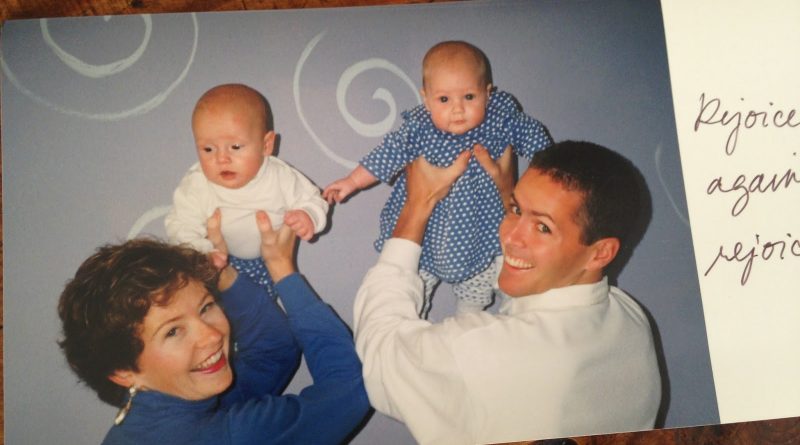
Rejoice in the Lord always; again I will say, rejoice! Philippians 4:4 Not sure if you got one of these in the mail. It was our Christmas card in 1994.We rejoiced in the Lord then, for he gave us more than we wanted–a baby, actually two babies, a…
In all relationships, communication is crucial. How often have we heard one half of a couple say: “My partner doesn’t understand me”Communication barriers can lead to breakdown and even separation – not something we want to ponder on this supposed…
As a parent with a child with autism I have felt deep devastation while reading articles in the news lately about terrible things happening to children on the autism spectrum. Any of these events could have very well happened to my child. It bothers me…
First off, let me apologize for being so incredibly absent on my blog. 2014 is proving to be a very interesting and fulfilling year! It’s amazing everything that has gone on and there’s so much to tell you all. But that all needs to wait…. I need t…
From around one year old, milestones around Isaac’s development became millstones around my neck. Waving, exploring, walking, talking – the lack of – burdens that bore down on me. Isaac’s angelic looks and throaty, totally contagious cackle was countered by a thunderous and tortuous, impossible to read despair and sadness. There was little else in terms of human interaction.
Indeed, global delay was Isaac’s first diagnosis, at around two and a half, with walking, succeeded at two, the only real milestone accomplished. The flow of his development from this point officially entered muddy waters, where what he’d achieve and when was impossible to predict. The many early learning devices and contraptions for coordination and comprehension were receiving scant attention from Isaac. The concept of cause and effect evading him. He babbled, but words did come, bizarre words mainly, bit by bit.
Then the diagnosis of autism. One mammoth milestone. The confirmation of a lifelong condition that would deposit many a milestone into a morass of maybes. Yet forlornly foraging around in the mental fallout from the diagnosis – after the shock, the tears, the reassurance, the genesis of readjustment – I did discover a perhaps perverse positive in this. A relief even. That maybes and milestones are ok. I broke free from the tyrannical mindset of ‘things must happen’ or ‘things must not happen’ ‘at certain times’. The anxiety ebbed somewhat.
After all, we’d entered the autism world, to all intents and purposes, an alternative world. Where, as someone once lyrically put, as a parent you arrived in Amsterdam, thinking you were going to Paris. Your stride, pace and flavour of life shifts.
This sat very comfortably with a paradox that is bang, smack in the centre of parenting a child like Isaac. Every minute of every day is planned assiduously. You learn to leave no stone unturned. No surprises. Events, visits, meeting people – all scripted tirelessly. Respect autism and expect no rebuttal. Yet, beyond the here and now, well, you don’t think in those terms. Days can be predicted, life’s journey – with its milestones around everything from riding a bike, to first friends, to birthday parties, to swimming, to teams and clubs, to sleepovers, to school plays, to hobbies, to exams, to parties – anything but. You take each heavily itemised, meticulously audited day at a time.
Life can loom large, instead, the limbo of treading water suited me well; stopping me sinking in fear over the future or sorrow over the past.
Very recently however, Isaac arrived at a milestone that struck me as fairly profound, and one that needed wrestling with.
Isaac has had the autism diagnosis for half his life.
It’s at once arbitrary and hugely monumental. And it’s the latter that’s taken command of my mind. I’ve never cowered from the gravity of Isaac’s autism. But with it being a massive part of all of us for half his eventful life, I’ve sensed the need to shift my sentiments of late, seeing it in some sort of bigger context. To step back from the day to day and look backwards as well as forwards. Milestones are back on my mental menu.
We have also been in the eye of a tumultuous, tense time with his anguish and insecurity. His ability to slump in seconds from a blissful state to genuinely crestfallen, never fails to surprise or upset me. I don’t doubt a conscious coming together of heightened challenges from him with the acknowledgement of this latest milestone. In a series of eureka moments (with a lower case e) the need has been impressed on me to objectively evaluate Isaac’s autism.
And what I see heartens me as much as it hurts me. Because I see autism amplified whenever developments are achieved.
A tremendous truth is that Isaac has reached many a milestone with aplomb.
He is developing into a social animal (did I ever think he would?). Initiating interaction. Starting conversations. Showing warmth. At school, this social juggernaut of a boy appears catapulted into the playground. With not mere gusto but the gust of a hurricane. The mini-monologues demonstrated both his vocabulary and propensity to repetition that can restrict him. “Welcome back. What’s your name? Who’s picking you up today? Say your mum, say your mum” These are said daily, with a charm – and a compulsion for confirmation. And frankly, other kids can be riled by the repetition. Not all. But walls of silence and huffs of irritation, are more than detectable. I worry, but my powers of doing anything are impotent.
Repetition comes with the autism territory. There’s a lot of it in my house. A side effect of the developing autistic brain. This is commensurate with not just diagnostic criteria, but anecdotal and empirical evidence from self-advocates (people with autism). It’s just one example of the double edged sword of a milestone accomplished in an autistic context.
Another being Isaac’s cognitive developments. The raw facts are promising and I hold them tightly. He reads (did I ever think he would?). Quite beautifully. Swiftly. To say (as a committed Thames Estuarian) I’m proud of his regal pronunciation is an understatement in the realms of the epic. His photographic memory is the engine that’s driven such a development. He gives short shrift to the typical learning of phonics – using sounds to make a word. It’s the whole word or nothing. So when he saw the word avenue for the first time, he preferred to say adventure than try and spell it out. Words like ‘Crescent’ for him is a breeze; once a word’s been seen and been told to him it’s in his head.
What seems to be in deficit is comprehension. Even a willingness or desire to imagine, immerse himself in the storytelling bit. Anything abstract of involving a need for analysis. Attempts to engage in these discussions irks him, it seems off his radar. This out of kilter way of learning could mean him coming unstuck mainstream learning, if no major attempt to galvanise his lesser abilities to inquire.
As with all things autistic, though, you’re never a million miles away from a little mirth. He insists on reading the ‘written by and illustrated by’ bye-lines at all time. And will end reading a book with ‘and now it’s time for the blurb’ paying little interest in the contents of said blurb. Imagination wise, he had no time for tooth fairies with the tooth being pragmatically exchanged with either parent for a gold coin. Dressing up day at school held no sway. On arrival at school, he proudly declared, “I’ve come as Isaac”. And then there was his dismay that there was no sign that said “Try something new today”, mummy, where is it?” on a visit to a poorly branded Sainsbury’s. It’s situations like these where his observational skills and outsider status are original and need no sorrow, only joy.
Where his long, logical learning march can lose momentum at best, at worst come crashing to a standstill, is his need to obsessively follow order and detail. You can practically hear the hum and whirl of his programming brain as he both processes his facts and then resolutely holds on to them and repeats them, somehow needing to say and say again, to give himself a psychological balance. His way of keeping calm in a chaotic, illogical world, perhaps.
And the smallest of anomalies are akin to mini crashes to his computer, with the ability to reboot, cloudy. Days, weeks, months, pm or am, the expansion to his temporal learning of late is extraordinary (nothing makes him more elated than the first day of the month, hurling himself out of bed to “see the clock, see the clock, it’s the 1st. So exciting. Wow. Daddy”).
“Daddy, on Feb 13, pm, you collected me from school and read books”. A fact plucked at random from this mind, he said yesterday, unprompted.
“Look at me daddy. Tomorrow when we wake up we will talk about going to Golders Green on the northern line. We did it yesterday, do you remember?”
“You are giving me a bath on April 21. Say yes!”
His days are punctuated with the need to affirm small events like this – from the past and about the future. To keep that equanimity in his consciousness. They are the tentacles of this ever more complicated calendar that inflicts his mind. With no margin for error. Again the unambiguous nature of autism diagnosis will always anchor Isaac to this behaviour that if not handled delicately with a finesse, can tip into the negative. In fact brain mapping and imaging research echoes this too and more – with evidence for overdevelopment in the regions that deal with decision making and the sorting of information.
An abundance of anxiety comes when there are inconsistencies to the detail. Which can implode in the form of a vicious circle. Hoarding, needing to locate a specific, meaningless toy he was playing with at the same time last week. Becoming agitated when it’s not there. Eschewing food. Refusing to do anything. Ignoring behaviour charts. Shamefully, I can’t help but be infuriated. The challenge, the real battle, is to see positive milestones reached, as opposed to bad, defiant behaviour. That, I think, needs a bigger picture, to view Isaac’s development – actually, it’s a critical coping mechanism. Face up to his changes, embrace milestones. Ones I once thought he’d never reach.
With all these emotional, social, and cognitive leaps he’s accomplishing then, autism has remained a tenacious presence. Even his self-awareness too with a new found ability to articulate his sensory discomforts. “It’s too strong, too strong, no thank you” referring to any clothes that aren’t super soft. Or “I banged my head” if he has, I think, a headache. Learned cues versus intuition and instinct induced expression.
Milestones in Isaac’s world come with an autistic sting in the tail. Controlling that sting will always be hard. Our levers of change restricted to simply ‘knowing it’s coming’. So sensing autism’s arrival is critical. Which means expecting him to keep on developing and reaching milestones is crucial too.