The Ability to Communicate Should Be Free
This article may contain affiliate links. Learn more
My son is a nonspeaking young adult. So I've spent a lot of years learning that communication comes with a price tag, and the price tag is printed in very small type.
About 30% of autistic kids stay minimally verbal even after years of services, according to a 2013 review in Autism Research that still gets cited everywhere. For those kids, and for the teens and adults they grow up to be, AAC (augmentative and alternative communication) is how they talk. And talking, it turns out, comes with a bill.
What AAC costs
Most families start with an app, so I will too. This is what Apple's US App Store listed for the big names when I checked on November 23, 2026:
| App | US App Store price | The fine print |
|---|---|---|
| Proloquo2Go | $249.99, one time | The Gateway vocabulary is another $149.99 |
| TouchChat HD | $149.99, one time | The WordPower vocabulary is another $149.99 |
| TouchChat HD with WordPower | $299.99, one time | Same app with WordPower included |
| LAMP Words for Life | $299.99, one time | Built around motor planning |
| TD Snap | Free to download | Speech takes a $9.99 monthly subscription after a one-month trial |
Then you need something to run it on. Apple's base iPad starts at $449. Add a case, because the iPad will get dropped. Possibly thrown. Possibly thrown with feeling.
For the bigger numbers, I'm borrowing from Pennsylvania. I live in Virginia, but Pennsylvania's Department of Human Services published a guide to finding and funding AAC that lays out the costs more clearly than anything else I found from a state agency. Costs, coverage and programs differ from state to state, so treat these as a ballpark and check what your own state offers.
Pennsylvania's guide estimates about $50 for a sturdy case and $500 to $800 for a basic tablet setup. A dedicated speech-generating device, the purpose-built kind, runs $1,800 to $8,000. An eye-gaze system starts around $16,000, which is used-car money.
The subscription crowd
There's a newer way to pay, too: by the month. At this year's ASHA convention (the big annual gathering of speech-language pathologists), about ten AAC apps on the floor were selling subscriptions.
Here's what the subscription apps I could price on their makers' own pages charge, checked November 23, 2026:
| App | Monthly | Yearly | What you get |
|---|---|---|---|
| InnerVoice | $19.99 | $199.99 | Basic use is free; the paid tier adds AI chat and AI board building |
| Spoken | $12.99 | $99 | Typing with word prediction; speaking stays free, Premium adds the better voices |
| Proloquo (AssistiveWare's newer app, not Proloquo2Go) | $9.99 | $99.99 | Symbol-based, with a one-month free trial |
| Avaz AAC | $9.99 | $99.99 | Symbols and typing, 14-day free trial |
| TD Snap | $9.99 | No yearly plan listed | The subscription is what makes it talk |
| Tala | $9.99 | $39.99 | Picture cards that speak phrases, 7-day free trial |
| CoughDrop | $9 | $295 for life instead | Two-month free trial |
| Cboard | $8 | $79 | Free version with ads; Pro adds better voices |
A $10 monthly bill looks friendlier than $300 up front, and for a family that can't find $300 this month, it is. The catch is that it doesn't end. Three years of TD Snap's speech subscription comes to $359.64, which is more than buying LAMP outright. Three years of InnerVoice at the monthly rate is $719.64. OpenAAC's State of AAC 2025 report says Tobii Dynavox's move to make TD Snap subscription-only "effectively raised the price for consumers."
Why so much?
Here's my theory: the big dedicated devices are priced for whoever is paying, and most of the time that isn't the parent.
Medicare treats a speech-generating device as durable medical equipment, according to ASHA's summary of Medicare's rules. It leaves out "personal computers, tablets or mobile devices that may be programmed to perform the same functions." Colorado Medicaid takes the same line, per a University of Colorado early intervention guide: families have to "request a dedicated SGD by name, even if it is a tablet-based device." In plain English, if insurance is paying, you'd better be asking for something built to be billed.
Those bills have ceilings, and somebody else sets them. Here in Virginia, Medicaid's 2026 fee schedule for communication devices pays $501.57 for the simplest recorded-message device and up to $8,681.12 for the top category, the kind with synthesized speech and more than one way to access it. Pennsylvania's guide puts dedicated devices at $1,800 to $8,000, which sits right inside that range. No maker says it prices off a Medicaid schedule, so that connection is my read, not theirs.
The same software can wear two price tags, too. Tobii Dynavox's TD I-110 comes "loaded with TD Snap," the same TD Snap that's $9.99 a month on an iPad in the table above. The I-110 page lists no price at all. Tobii's funding page says instead that "most of our devices are eligible for coverage under Medicare, Medicaid, and Private Insurance."
The $150 to $300 iPad apps are a different animal. Insurance generally won't buy the iPad they run on, so parents and schools usually pay out of pocket for the whole setup. Spoken, which sells a competing app, is blunter about the devices on its own site: "The usual reason they cost so much is because they're priced for insurance companies, not everyday users." That's their opinion, and they have a horse in the race.
Even when insurance pays, it isn't free. There's an evaluation, device trials and paperwork, which I'll get to. And Virginia Medicaid says flat out that "communication devices to improve educational and/or vocational abilities are not covered services." A device for school or work falls into that gap, and the gap is exactly where a free board earns its keep.
Why so many parents hit a wall
Insurance will often help with the expensive thing and not the cheap one. Medicare's coverage rules say computers and tablets generally aren't durable medical equipment because they're "useful in the absence of an illness or injury." Medicare will pay for speech software on a tablet, but not the tablet. It also expects a device to last five years and denies upgrades inside that window. Kids, rudely, keep growing anyway. Medicaid and private plans write their own rules, and those vary by state and by plan.
Pennsylvania's guide also points out that insurance wants a formal evaluation, device trials included, before it pays for a speech-generating device. That's the right way to match a kid to a device. It's also more appointments and more paperwork, piled onto a family calendar that already looks like an air traffic control board.
OpenAAC's report gave AAC funding a D+. I've seen report cards like that. Usually there's a parent-teacher conference involved.
So a parent picks one: wait on an evaluation and an approval, put $700 on a credit card, sign up for one more monthly bill, or laminate a homemade board and hope. Meanwhile a kid's ability to say "stop," "help" or "that hurts" rides on a budget, a plan's fine print and a waiting period. Nobody makes a speaking kid get prior authorization before saying "more."
The ability to communicate should be free. Not discounted. Not free for 30 days. Not $9.99 a month after the trial. Free.
What schools and therapists are up against
Schools are supposed to help, and on paper they do. Under the Individuals with Disabilities Education Act (IDEA), every time an IEP team writes, reviews or revises a child's IEP, it has to consider whether the child needs assistive technology. If the team decides a device is necessary, the district has to provide it and pay for it, according to U.S. Department of Education guidance from January 2024. That guidance even uses the example of a nonverbal four-year-old who needs an AAC device.
The catch is that the device often belongs to the school, and life keeps going after the 3:15 bell. People who answered OpenAAC's 2025 survey brought up devices not always being available. The Education Department says a family and a district can agree to use the child's own device instead, as long as the family agrees freely and things like app and subscription costs get worked out.


Then there's training. ASHA's 2022 Schools Survey found that 71.2% of school-based speech-language pathologists (SLPs) regularly serve students who use AAC. In a 2021 survey of 272 school SLPs, though, 29% never took an AAC course in grad school, and the group felt least confident matching the features of high-tech devices to their students. In a 2023 survey of 726 SLP grad students, 40% didn't feel ready to work with AAC users after graduation (both figures as reported in Eddy, Sorensen and Pinto, 2024). OpenAAC gave AAC education an F and noted that school staff often skip modeling on a device because finding the words is hard.
I'm not blaming SLPs. They carry big caseloads, juggle a pile of systems, and plenty of them learned AAC on the job.
As for that pile of systems, OpenAAC's survey names TouchChat, TD Snap, LAMP, Proloquo2Go and Grid as the most-mentioned apps, along with plenty of low-tech picture boards and PECS-style books. When a child switches systems, from home to school or from one app to the next, the words end up in new places. The child has to learn where everything lives all over again.
A free AAC board, for everyone
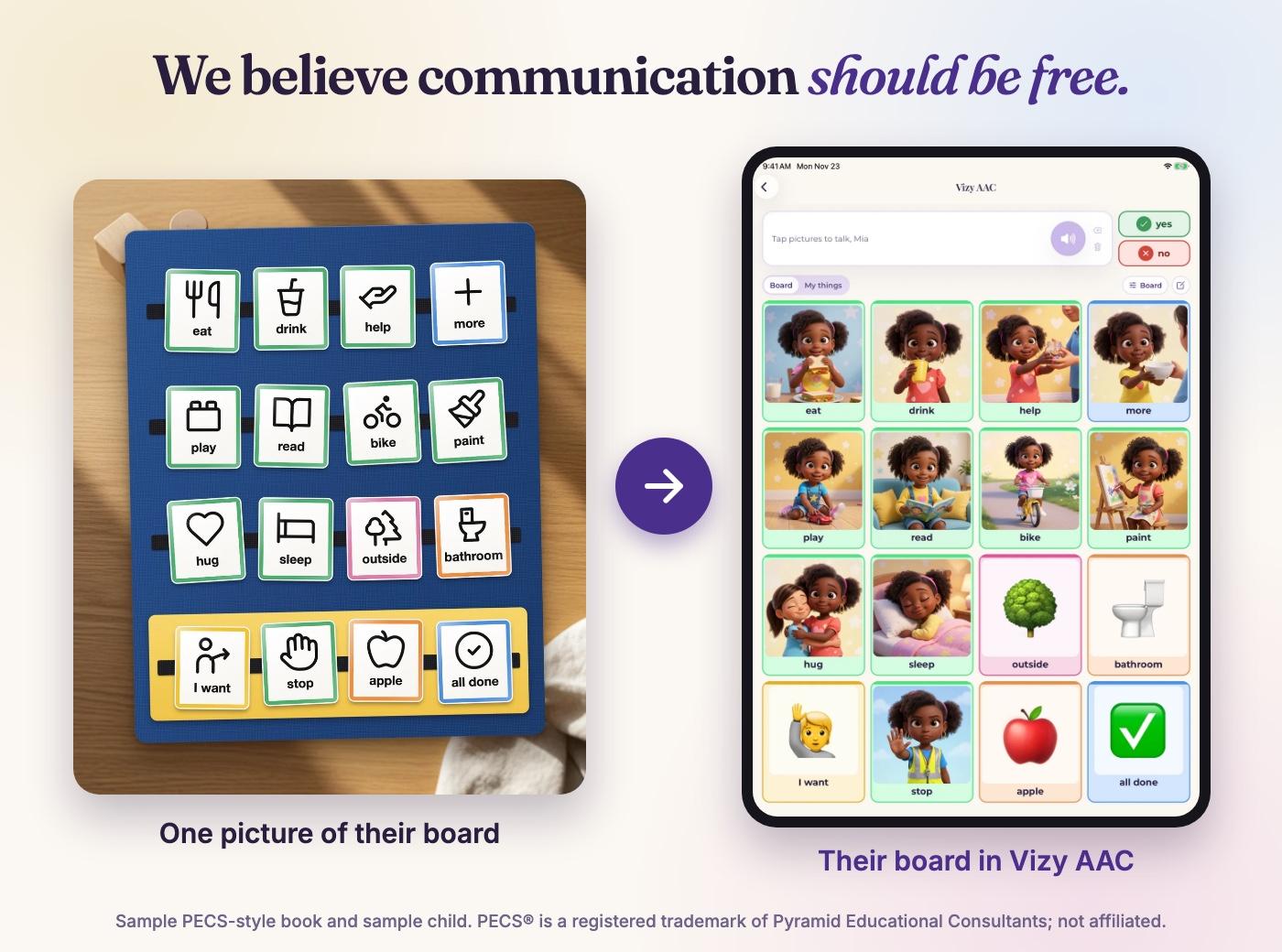
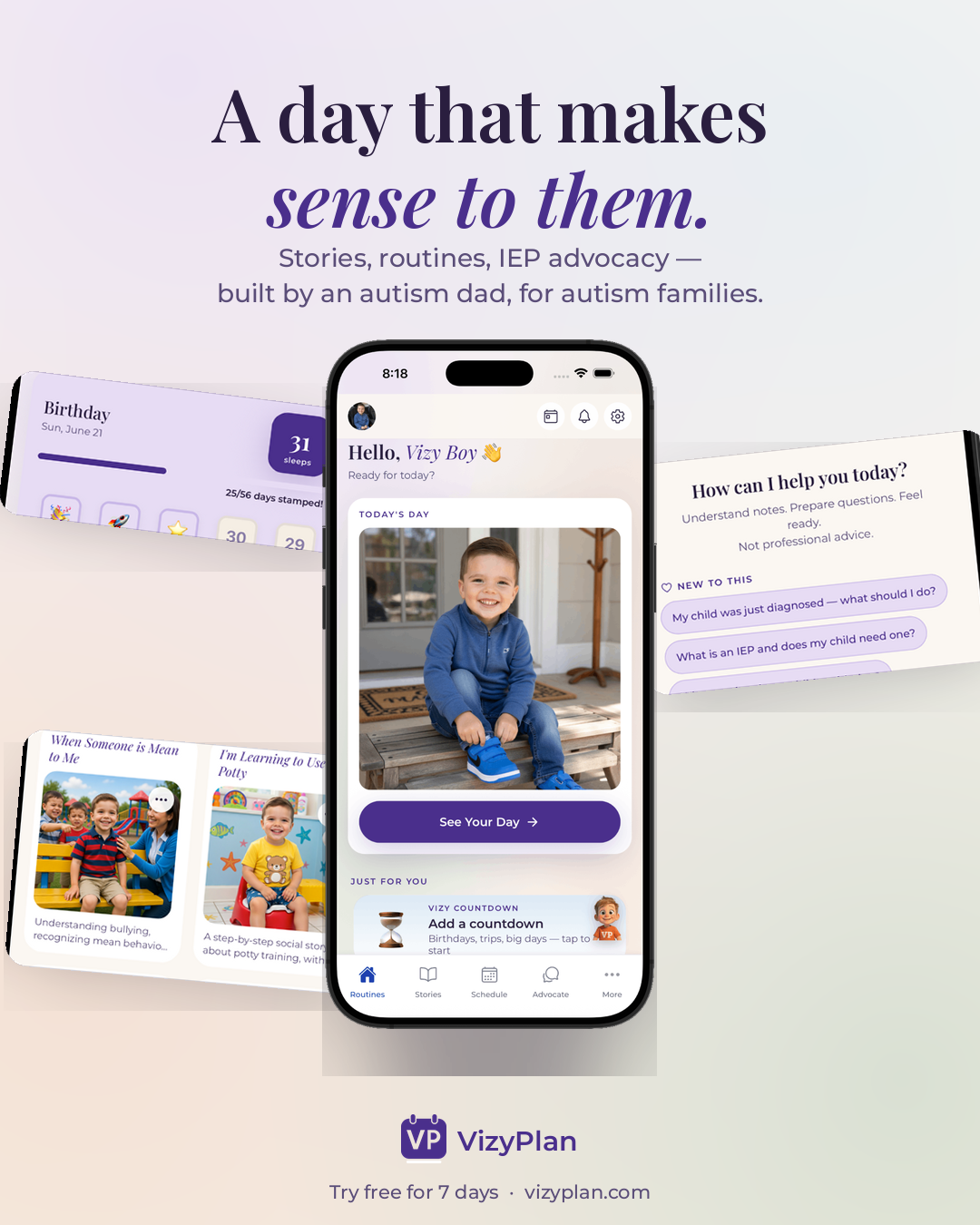
VizyPlan just launched Vizy AAC, a picture communication board that comes free with every VizyPlan download. Their line: "We believe communication should be free." Some of VizyPlan's AI features cost money. The AAC board doesn't, and VizyPlan says it stays free.
Full disclosure: VizyPlan's founder, Justin Bowman, is rebuilding Autisable's website as part of a barter partnership, and Autisable shares VizyPlan's content. I'd write this post anyway. You should still know.
Here's how it stacks up against the subscription apps above:
| The subscription apps above | Vizy AAC | |
|---|---|---|
| Cost to speak | $8 to $20 a month for the paid tiers | Free |
| Free trial | 7 days to 2 months | No trial. It stays free |
| Bringing over a paper board | InnerVoice can turn a photo of a board into a talking board | One photo or a CSV rebuilds it with the same words and places (beta) |
| Vocabulary | Thousands of words; Avaz lists more than 40,000 SymbolStix pictures | 36 core words, starting with 6 |
| Voices and languages | Many, depending on the app | A boy or girl voice, English or Spanish |
The big apps carry a lot more words. If your child needs a full vocabulary, that's what they're built for. Vizy AAC aims at the first words that matter most, and it doesn't send a bill.
Here's what it does, per VizyPlan's own page:
It's personal. Your child can see themselves on their own board. The picture for "want" is them. Words and full sentences are spoken aloud.
Words don't move. It's built on the 36 Universal Core words from Project Core at UNC. A child starts with six (want, go, stop, help, more, finished) and grows to 12, 20 and then all 36, and no word ever changes places. Learn where "help" lives once, and it lives there for good.
It goes where your kid goes. It works upright or sideways. On iPhone and iPad it keeps working without internet after the first open, back seat of the car included. The web version needs a connection.
SLPs had a hand in it. VizyPlan says it was designed with input from SLPs, OTs and behavioral specialists, and built by an autism dad and a licensed SLP.
Already have a PECS book? Bring it with you
This is the part I'd want most as a parent, and it's in beta right now. If your child already uses a PECS book or another picture board, you don't start from scratch. Take one picture of the board (or import a CSV), and VizyPlan rebuilds it with the same words, the same places, the same colors and the same folders. A grown-up checks it first, fixes any word that came through wrong, and taps "Use this board." VizyPlan says the picture you add is read once and not kept.
So your kid goes from paper to tablet without losing what they already know. Beta means you may hit a rough edge or two, so tell VizyPlan what you find.
One picture of a PECS-style book, rebuilt in Vizy AAC. Turn the sound on to hear it talk. Video courtesy of VizyPlan.
Who it's for
If you're a parent priced out of the big apps, try it. If you're an SLP or teacher who needs a no-cost option for a family, or a bridge between a paper book and a device, try it. If you're an autistic teen or adult who uses AAC, tell me what you think in the comments. You know this better than any of us.
It doesn't replace an AAC evaluation. If your child needs eye gaze, switch access or a dedicated device, keep working with your SLP on that. But no family should have to wait on a credit limit to give a kid a way to say "stop."
Try Vizy AAC free at vizyplan.com/aac.
Everyone has something to say. It shouldn't cost $9.99 a month to say it.
Prices were checked on November 23, 2026, and can change. Pennsylvania's cost ranges are that guide's estimates, not quotes.


Disclosure: Autisable.com participates in affiliate programs, including the Amazon Services LLC Associates Program and other affiliate advertising programs. This means we may earn commissions from qualifying purchases at no additional cost to you.
Comments
Join the community to leave a comment.