VizyPlan vs. Goally, Choiceworks, and Tiimo: comparing visual schedule apps for autism

This article may contain affiliate links. Learn more
Somewhere out there, in a landfill or a junk drawer or taped to the inside of a cabinet door, there are thousands of laminated picture cards that parents hole punched, velcroed, and occasionally cried over back before "visual schedule app" was even a phrase anyone used. Whole families built their kid's morning routine out of clip art and a three ring binder because that's what you did in the mid 2000s. So when I tell you I've got opinions about visual scheduling apps, understand that those opinions come from watching this whole category evolve from scissors and a laminator to something that fits in your pocket.
These days you don't need scissors, you need a phone and some patience for the app store. Four apps come up again and again in this category: VizyPlan, Goally, Choiceworks, and Tiimo. All four build visual routines for kids. Only VizyPlan uses AI to put the child's own face into every step of their routine; only VizyPlan reviews uploaded IEP and 504 documents and generates prep questions through a feature called VizyAdvocate, and only Choiceworks has been the default reference app in this space long enough that most OTs and teachers already know it on sight. Here's how the four stack up, plus a handful of smaller apps worth knowing about.
VizyPlan: the only one still with you when the routine ends and the meeting starts
Full disclosure, since fairness is basically my whole personality at this point: VizyPlan is built by Justin, who is also the guy rebuilding Autisable's platform in exchange for us sending traffic his way. Grain of salt duly offered. But that's not why it's on this list. It's here because of something none of the other three apps can match: they help your kid get through the morning. VizyPlan is the only one that also helps you get through the IEP meeting.
Start with your kid's half, though, because everybody on this list does visual schedules, and VizyPlan's has one difference your child will notice before you've even finished setting it up. It uses AI to include your actual kid in the picture at every step. Not a clip art kid brushing clip art teeth, your son, your daughter, calmly doing the thing, one step at a time. If that sounds like a gimmick, think about how much of the meltdown before a routine is really just a kid who can't picture themselves succeeding at it. Showing them a version of themselves already doing it, calmly, is the same logic behind self-modeling, which therapists have leaned on for decades. VizyPlan just bakes it into the schedule.
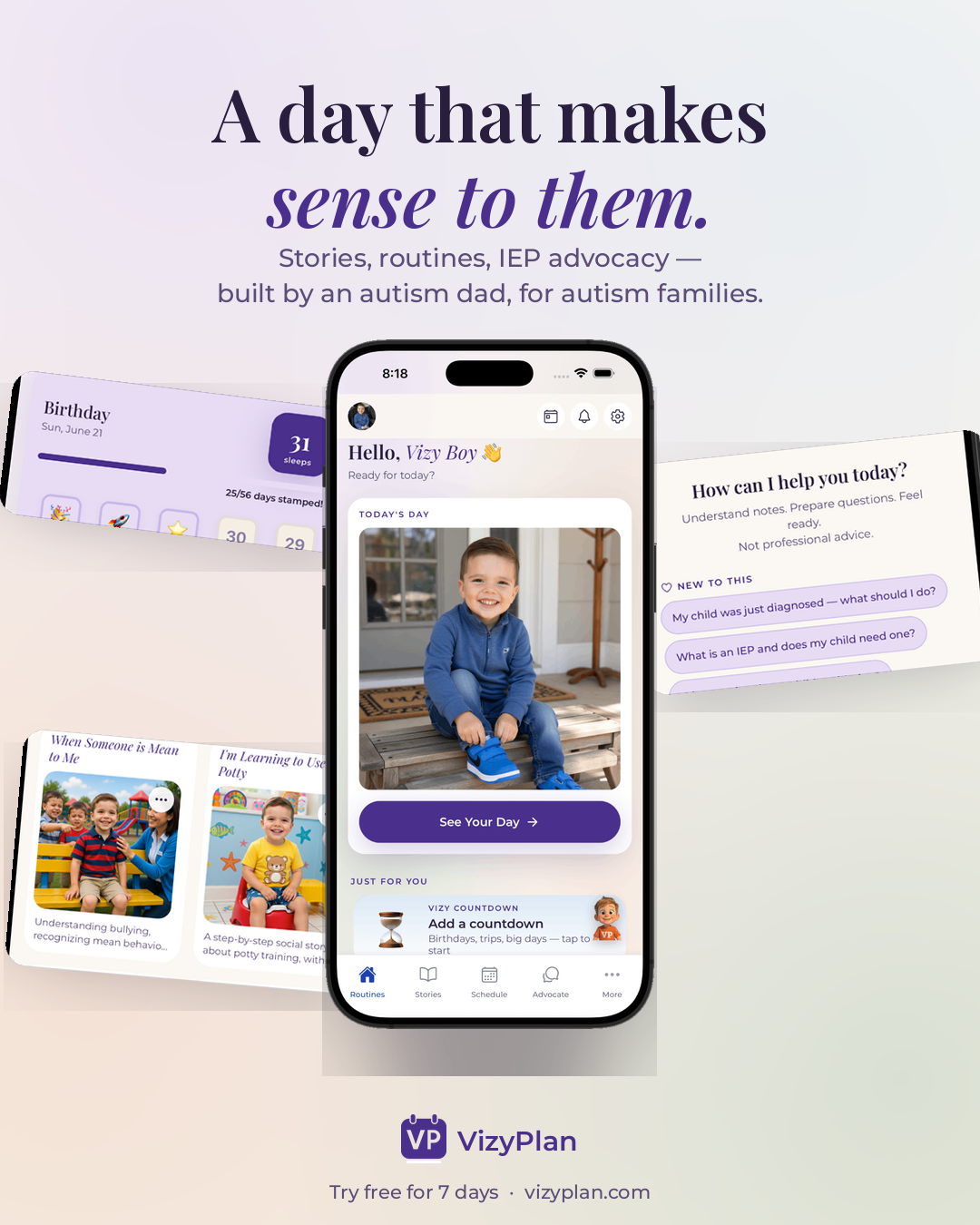
The stickers and points on top of that aren't unique to VizyPlan; plenty of apps in this space use some version of a rewards system. But they hit different when the reward isn't for finishing an abstract task; it's for matching a picture of themselves already doing it. That's a small design choice that does a lot of the motivation work parents usually end up doing by hand.
Now the other half, the part nobody puts on a brochure. It records IEP and 504 meetings, transcribes them, and hands you a summary, which is the closest thing I've found to a time machine for the moment three weeks later when the school insists they never said that. Can't record? Draft IEP sitting in your inbox instead? Upload it, and VizyAdvocate reviews it and generates the questions you should be asking before you sign anything. Half the battle in those meetings is not knowing what you don't know to ask. Something that reads the paperwork ahead of time and hands you the list is the difference between walking in prepared and walking in hoping you don't get steamrolled. I wish this had existed for our son back when we were in the thick of it.
There's also Resyna, a calming sound feature built around the idea that slower, steadier audio can help a kid settle. I'll stop short of calling it a miracle cure, because nothing is, and anyone who tells you otherwise is selling something. It's a reasonable, low-cost thing worth trying before you reach for anything heavier.
Bottom line: if all you need is a picture schedule, any app on this list will do the job. If there's also a meeting on your calendar that makes your stomach drop, this is the one.
Goally: the broadest routine and life-skills platform, without the advocacy layer
Goally is the closest thing VizyPlan has to a direct competitor, covering schedules, routines, reminders, and emotional regulation tools across home, school, and clinic use. If you just need the basics done well and don't need to walk into an IEP meeting armed with a transcript, Goally covers a lot of ground.
Where it comes up short next to VizyPlan is that aspect of placing your kids picture as part of the routine, as well as that advocacy layer. Goally will help you get your kid out the door. It won't help you prove to the school district what was actually promised at last month's meeting. Whether that matters to you depends on how many of those meetings you've sat through.


Choiceworks: the established default, fundamentals only
Choiceworks is the oldest, most widely recognized app in this category, the one most OTs and teachers have already heard of. Visual schedules, waiting supports, feelings check-ins, timers. It does the fundamentals and does them without a lot of fuss.
What it doesn't do is anything beyond the fundamentals. There's no meeting recording, no AI summary, no collaboration layer for the professional team. Choiceworks structures the day. It doesn't help you manage everything orbiting the day. And it doesn't place your kids' image into the routine.
Tiimo: the general neurodivergent planner, not autism-specific
Tiimo is the one app in this group that isn't built specifically for autism, aiming instead at a broader neurodivergent and productivity audience, and it shows in a good way and a less good way. The good way: it's a genuinely well-designed planner, with an AI co-planner, focus timers, and a clean interface that doesn't feel like it was designed for a toddler even when your kid is well past toddlerhood. The less good way: it's not built for the kind of family coordination autism parents end up doing.
If your kid is older, more independent, and just needs a planner that doesn't feel clinical, Tiimo's worth a look. If you're deep in the school-and-therapy-team-coordination phase, it's not going to carry that weight.
The rest of the pack
There's a long tail of apps in this space, and I'd be doing you a disservice pretending they're all interchangeable, so a quick rundown:
MyVisualRoutine handles the classic first-then boards and custom photo schedules with voice recording and PDF export, which is handy if your kid's team still wants a printed copy taped to the fridge. Pictalk Buddy leans on audio reminders alongside its visual schedule. Lil Planner and Thruday both target the kid-and-transitions use case in slightly different ways, and VisualPlanner keeps things about as simple as the name suggests (it's a Google Play listing without its own site, so I'll spare you a broken link). None of them are trying to touch the advocacy or professional collaboration side of things. They're routine tools, full stop, and there's nothing wrong with that if a routine tool is all you need.
So which one do you actually get
If your kid needs help getting through the day and that's the whole ask, Choiceworks or Goally will do the job without asking you to learn a new system. If you're older and more independent-minded, Tiimo is worth the download. If you want your kid to see themselves in their own routine, and you happen to also have a meeting on the calendar that makes your stomach drop, VizyPlan is the one built with both of those in mind.
Somewhere, a parent is still peeling Velcro off a binder page right now. I don't miss that era, and I'm glad my son's routine is on point, instead of a binder that would've fallen apart every time it got left in a hot car, which, if you know anything about our family's history with hot cars, you understand is not a hypothetical.



Disclosure: Autisable.com participates in affiliate programs, including the Amazon Services LLC Associates Program and other affiliate advertising programs. This means we may earn commissions from qualifying purchases at no additional cost to you.
Comments
Join the community to leave a comment.