When "protecting kids online" locked autistic kids out
This article may contain affiliate links. Learn more
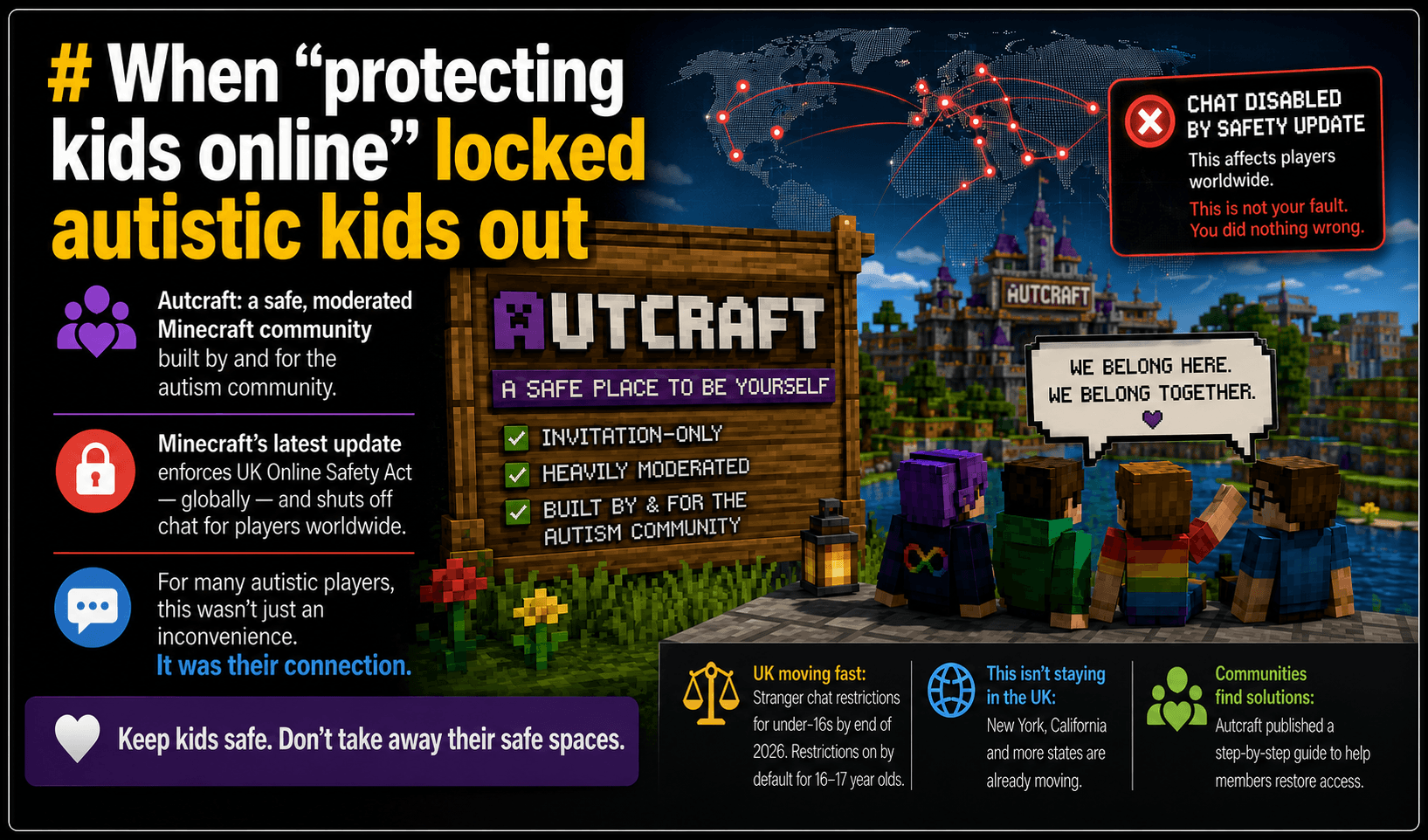
Stuart Duncan built Autcraft because the regular internet wasn't safe enough for his son.
That's worth sitting with for a second. He didn't build it because he had a cool business idea or because Minecraft needed another server. He built it because his kid — and kids like his kid — were getting bullied off a game they loved, and nobody was doing anything about it. So he did something about it. That was 2013.
Today, Autcraft has thousands of members. It's invitation-only, heavily moderated, and has probably logged more hours of safe, meaningful social interaction for autistic kids than most formal social skills programs ever will. It's one of the few places on the internet that was specifically designed by and for the autism community, and it works.
Which makes what happened recently particularly hard to swallow.
What Minecraft's latest update actually did
In mid-2026, Microsoft updated Minecraft to enforce the UK's Online Safety Act 2023. The idea, at least on paper, is reasonable enough: verify that adult players are actually adults before letting them chat with minors. Fine. Nobody's arguing against keeping predators away from kids.
The problem was the execution.
Players started logging onto Autcraft and discovering they couldn't use the chat. Not players in the UK. Players in New Zealand. Japan. Germany. South Africa. Players who have nothing to do with UK law, who aren't subject to UK jurisdiction, who just wanted to say hello to their friends on a Minecraft server for autistic people — and suddenly couldn't.
Stuart Duncan's team posted about it directly: "If you get into Minecraft and find that you can not use the chat, it is NOT because you did anything wrong."
That's a remarkable thing to have to tell your community. But that's where things landed.
Duncan has been vocal about his frustration, and his frustration is well-placed. He's noted that forcing players to hand over identification or clear automated age verification hurdles isn't making autistic players safer. The people who needed to be protected weren't the ones being helped by this rollout. The people who were already in a safe environment — a moderated, invitation-only server purpose-built for this community — were the ones getting shut out.
Why does this hit different for autistic players?
Here's something that doesn't always make it into policy discussions about online safety: for a lot of autistic kids and young adults, the social interaction they find online isn't supplemental. It's primary.
Not because they're addicted to screens or because their parents aren't paying attention. Because text-based communication can be genuinely easier to navigate. Because a Minecraft server with clear rules and consistent moderation is, for many autistic people, more predictable and less overwhelming than a school cafeteria. Because a space where everyone knows the social contract removes a layer of ambiguity that can make in-person interaction exhausting.
Autcraft understood this from day one. That's the whole point of it.
When the chat went dark, it wasn't just an inconvenience. For some of those players, it was the loss of a social outlet they didn't have a replacement for.
The bigger picture, and why it's coming here too
The UK isn't done. A national consultation that ran from March to May 2026 showed overwhelming public support for further restrictions — and the government has since confirmed it's moving forward. Under-16s will face stranger communication restrictions not just on social media, but on gaming platforms. For 16 and 17 year olds, those restrictions will be on by default.
The regulatory machinery to move fast already exists. The Children's Wellbeing and Schools Act received Royal Assent in April 2026, giving the government power to implement restrictions through secondary legislation without waiting for a new parliamentary bill. Ministers have said they intend to act by the end of 2026.
And if you think this stays in the UK, look at what's already happening here. New York State introduced the Children's Online Safety Act in May 2026, requiring mandatory age verification for any online platform with chat functions. California is considering requiring age verification at the operating system level. Multiple states have filed lawsuits against gaming platforms. Discord announced it's implementing age restrictions in the second half of 2026.
This is the direction everything is moving.
What Autcraft is doing about it
Duncan's team published a detailed guide walking families through how to check dates of birth in Microsoft accounts and adjust Xbox privacy settings to restore lost chat access. If you're an Autcraft member or the parent of one and you're still having trouble, their forum post is the place to start.
It's worth noting: this is what a community-first organization does when a policy fails its members. It doesn't wait for Microsoft to fix it. It figures out the workaround and publishes it.
The thing that keeps nagging at me
I've been running Autisable since 2009. I've watched a lot of well-intentioned policy hit our community sideways. And the pattern is pretty consistent: rules get written with a general population in mind, and the autism community — which often has a different relationship with online spaces, digital communication, and social access — ends up as an afterthought.
The intent behind the UK Online Safety Act is not the problem. Nobody reasonable is arguing that we shouldn't protect kids online. The problem is what happens when implementation is sloppy, when compliance is global but exemptions aren't, and when the people writing the rules don't have Stuart Duncan in the room.
He's been doing this for over a decade. He knows what his community needs. And his community just had its chat turned off.
That's the part that should bother all of us.
Stuart Duncan is the founder of Autcraft, a moderated Minecraft server for autistic children and adults. If you're experiencing chat restrictions on the server, visit their forum post for guidance on restoring access.


Disclosure: Autisable.com participates in affiliate programs, including the Amazon Services LLC Associates Program and other affiliate advertising programs. This means we may earn commissions from qualifying purchases at no additional cost to you.
Comments
Join the community to leave a comment.