Understanding the Key Differences Between ABA and DTT
This article may contain affiliate links. Learn more
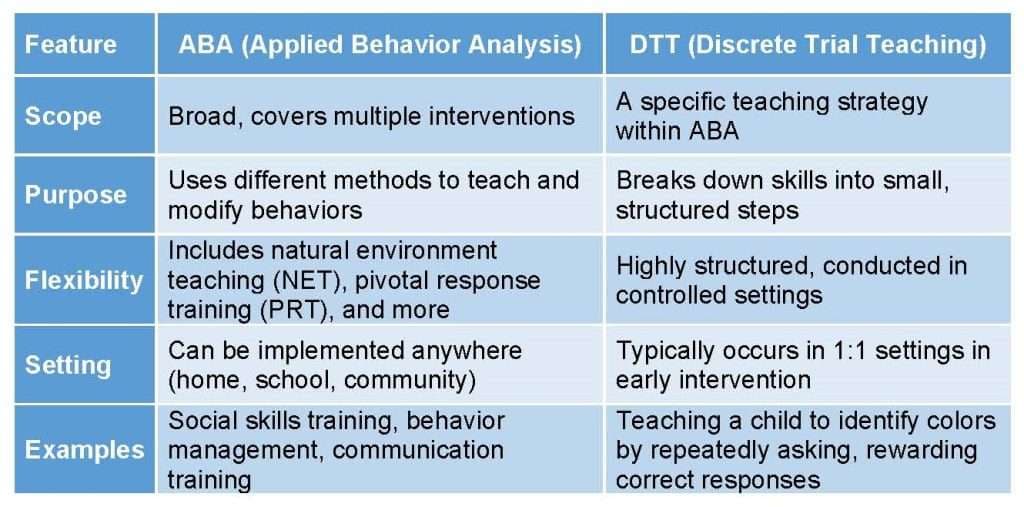
If you’re new to behavioral interventions, you might have heard Applied Behavior Analysis (ABA) and Discrete Trial Teaching (DTT) used interchangeably. While they are closely related, they are not the same. DTT is just one of many techniques used within ABA. ABA is a broad, science-based approach to understanding and modifying behavior, while DTT is a specific instructional method within ABA that focuses on structured teaching.
The Broad Scope of ABA
ABA is a scientific approach that applies principles of learning and behavior to improve socially significant skills. It is widely used to support individuals with Autism Spectrum Disorder (ASD), ADHD, developmental disabilities, and other behavioral challenges.
Key Areas of ABA Application:
- Skill Development – Teaching communication, academics, and life skills
- Behavior Reduction – Managing challenging behaviors like aggression and self-injury
- Social Skills Training – Encouraging interaction, play, and relationship-building
- Functional Communication – Enhancing verbal and non-verbal communication
- Independence & Daily Living – Teaching self-care, hygiene, and time management
ABA is not limited to a single method—it includes a variety of evidence-based techniques such as:
- Natural Environment Teaching (NET) – Learning through play and everyday interactions
- Pivotal Response Training (PRT) – Focusing on motivation and social engagement
- Functional Communication Training (FCT) – Replacing problem behaviors with effective communication
- Discrete Trial Teaching (DTT) – A structured teaching method (explained below)
ABA is flexible and can be applied in multiple settings—home, school, community, and therapy centers.


What is Discrete Trial Teaching (DTT)?
DTT is a structured teaching method within ABA where complex skills are broken into small steps. Each step is taught individually and reinforced until mastered. A typical discrete trial consists of:
- Instruction (Antecedent) – The therapist gives a prompt (e.g., “What’s this color?”).
- Response (Behavior) – The child responds (e.g., “Red”).
- Consequence (Reinforcement or Correction) – If correct, reinforcement is given (e.g., praise, a token). If incorrect, corrective feedback is provided.
DTT is especially effective for children with Autism Spectrum Disorder (ASD) because it teaches foundational skills through repetition. It is also sometimes used by therapists for children with ADHD.
Key Differences Between

Videos on Discrete Trial Teaching
To better understand Discrete Trial Teaching in action, here are some helpful videos:
How to Get an Expert Evaluation & Diagnosis
If you suspect that your child may benefit from ABA and DTT, getting a professional evaluation is the first step. For those of you who are new to my articles, I am a Child Clinical Psychologist and Certified School Psychologist, specializing in assessing children with Autism, ADHD, and behavioral challenges. I will be happy to help your family with evaluations, diagnosis, and treatment. To schedule an appointment with me, call (724)-850-7200. A proper evaluation can help determine the best intervention plan, ensuring your child receives the most effective support tailored to their needs.
Final Thoughts
Understanding the difference between ABA and DTT is crucial for parents, educators, and therapists working with children who need behavioral support. ABA is an overarching science, while Discrete Trial Teaching is just one of many effective techniques. Knowing when and how to use it, along with other ABA-based strategies, can significantly improve a child’s learning and development. Have you used ABA or DTT in therapy or teaching? Share your experiences in the comments!
This post was originally published elsewhere. Read the original post →
Article by
Dr. John Carosso
Dr. Carosso has more than 30 years of experience as a licensed Child Clinical Psychologist and Certified School Psychologist working through his own practice, and in residential, inpatient, outpatient, school, and home settings. He is a partner and Clinical Director of Community Psychiatric Centers (cpcwecare.com), a licensed Behavioral Health Outpatient Clinic, and operates both the Autism Center of Pittsburgh (autismcenterofpittsburgh.com) and the Dyslexia Diagnostic and Treatment Center (dyslexiatreaters.com). Dr. Carosso, who holds a Graduate Certificate in Applied Behavioral Analysis in Special Education, has conducted more than 20,000 evaluations on children with autism, learning problems and dyslexia, attention-deficit, trauma, depression, bipolar, anxiety, obsessive compulsive disorder, and related difficulties. He has supervised dozens of clinical teams and regularly provides consultation to organizations, agencies, and parents at 6 office locations in four counties counties. Dr. Carosso also has presented at regional conferences, served on the advisory boards of local autism societies, and has served for over 10 years as an evaluator and expert witness in child welfare cases. He produces a video series, "Dr. C's Morning Minute," that provides helpful strategies for effectively managing childhood autism, ADHD, and behavioral, emotional and learning issues. Dr. Carosso formerly co-hosted the Live weekly PCNC cable television program "Community Psychiatric Centers Presents", targeting child mental health issues, and was a regular guest on various talk shows, including "Night Talk", discussing childhood issues and related current events.


Disclosure: Autisable.com participates in affiliate programs, including the Amazon Services LLC Associates Program and other affiliate advertising programs. This means we may earn commissions from qualifying purchases at no additional cost to you.
Comments
Join the community to leave a comment.