How to Encourage Eye Movement Skills in Toddlers
This article may contain affiliate links. Learn more
Have you ever thought about watching your toddler’s eye movements during purposeful play? When my now young adults were toddlers, I looked at the pictures in the book with them. Once they could sit up, they often sat in my lap leaning against me. Other times, I sat near them with my focus on the toy. Oh how I wished I had known how to encourage eye movement skills in toddlers, also called visual processing skills. Why? Because visual processing difficulties interfered with my daughter’s ability to work at her level of intelligence.
As a toddler, my daughter resisted crawling, but she loved to climb. My son did not attempt to run until almost four years of age. How do you encourage the development of eye movement skills in your toddler? By first learning about the different stages of visual development and what to observe through developmentally appropriate play.
Eye Movement Skills in Toddlers: 9 ½ to 12 Months
Toys are great tools to help you encourage eye movement skills needed for visual-motor skills in crawlers and toddlers. However, have you ever noticed how crawlers and toddlers are much more interested in what you are doing, your tools versus their toys? Once steady on their feet, they delight in having their own little broom or a mixing bowl and a spoon. Toddlers watch and imitate everything.
- Look at objects in their hands with great interest.
- Pick up everything, look, and maybe even taste.
Activity: Containers and Lids
Once my granddaughter could walk, she loved pulling items out of the recycling bin to look at them. Would they fit in a mixing bowl? Her mommy made sure nothing unsafe went in the bin. I fondly remember her discovering containers and lids. She practiced pushing the lid on and pulling it off. Empty seasoning jars were the perfect size for her little hands. You really can turn trash into treasure. Free toys!
- Is your baby actively exploring using their hands, feet, eyes, ears, and mouth?
Eye Movement Skills in Toddlers: 1 Year to 18 Months
- Plays using both hands.
- Interacts with objects learning to focus on the object in front of them.
- Watches a moving object by moving their eyes and head.
- Uses their side peripheral vision to successfully move their hands.
- Continues to develop depth perception.
Activity – Dump, Fill, & Repeat Develops Eye Teaming and Tracking
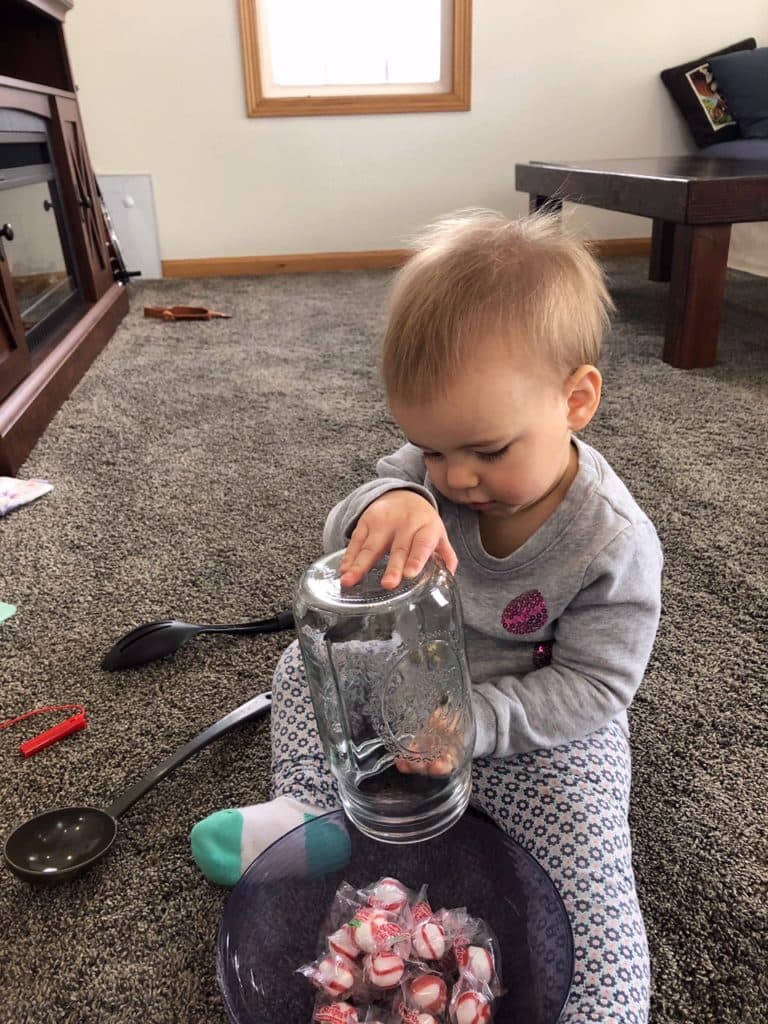
During the holidays, I enjoy baking with soft peppermints. My granddaughter, Shelby, who was 14 months old, intently watched me put individually wrapped peppermints in a durable canning jar. She seemed to love the crinkly sound of the wrapped peppermints. When I was done, I placed the canning jar on the table. Much to my surprise, Shelby purposely picked up the jar of peppermints and walked out of the kitchen. I followed curious as to her intent.
- Does your toddler notice and choose toys or an object of interest placed above them, in front of them, and/or low near the ground?
She sat down in the living room by her play bowl and spoons. Briefly, she looked up to see if I was watching. It took a few minutes before she arranged everything to her liking. Babies play with toys according to their eye movement skill abilities. She placed the jar on her left side. Then, she moved the bowl between her legs. Promptly, she emptied the peppermints into the bowl. Wow! They all landed in the bowl.
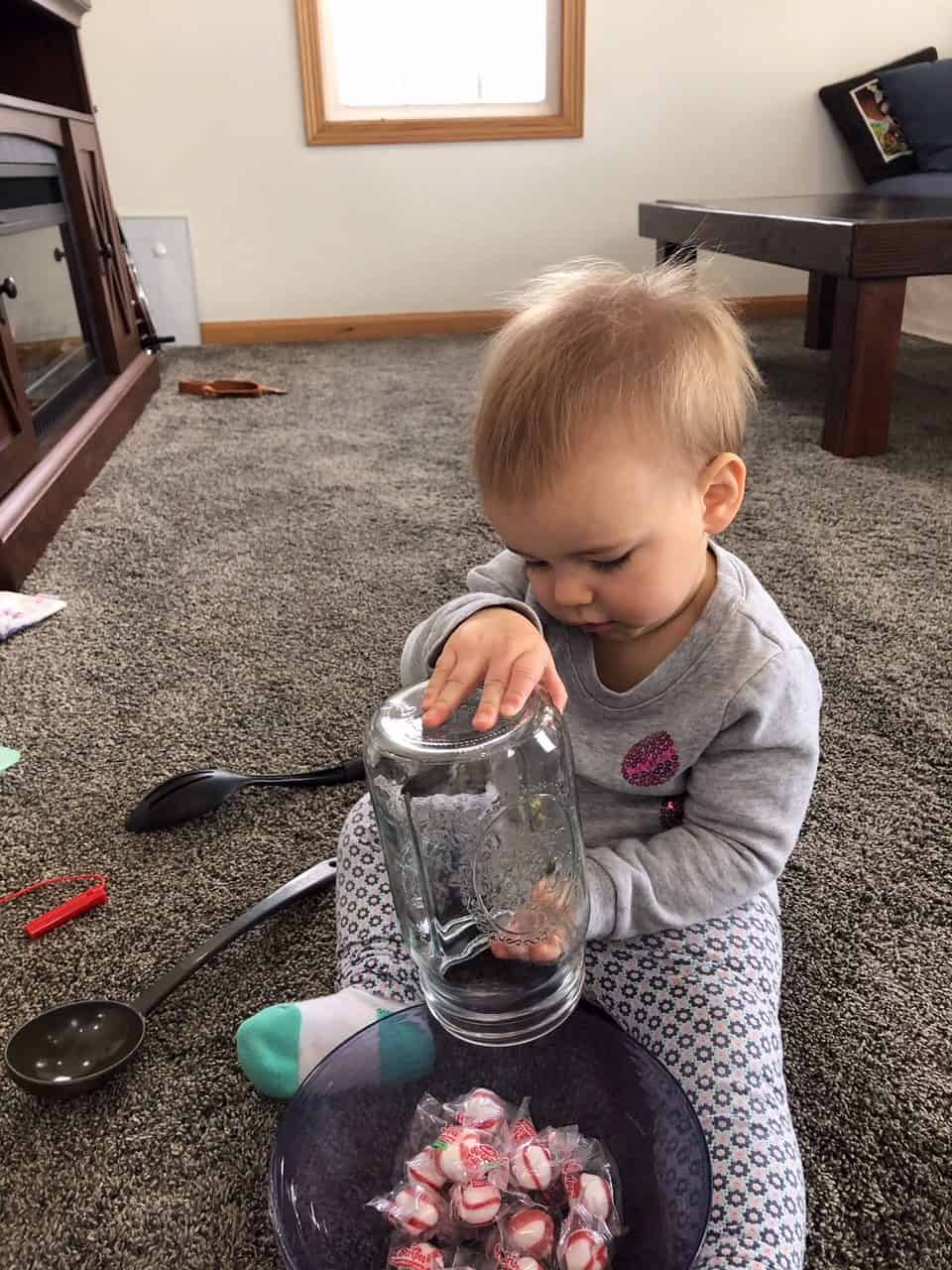
I sat and watched amazed by her level of coordination and hard work. Her mommy encourages her to tough through some hard work by simply waiting, watching, and smiling. She worked and concentrated for so long that I became a bit antsy; thus, these wonderful pictures.
Purposeful Play Encourages Eye Movement Skills in Toddlers
Hand preference develops with eye movement skills in toddlers. See the spoon a bit behind Shelby? That spoon was rejected because it did not scoop up and keep the candy in its ladle. Instead, Shelby chose the spoon with the deeper ladle. Most of the time, she used her right hand to hold the spoon. When compared to left-handed attempts, Shelby experienced much more success putting the peppermints in the jar with her right hand. It is amazing that at 14 months Shelby was already developing hand and eye dominance.
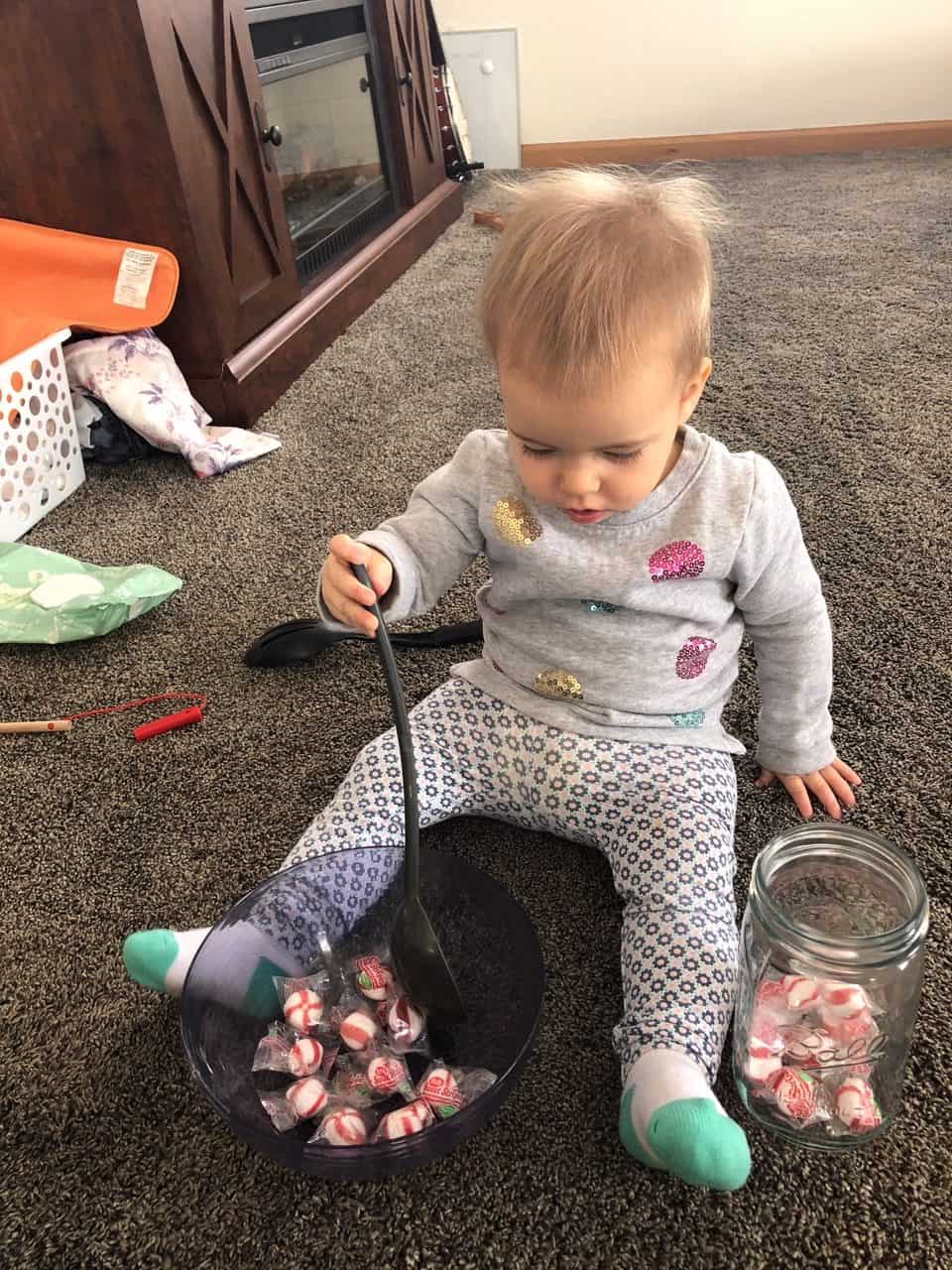
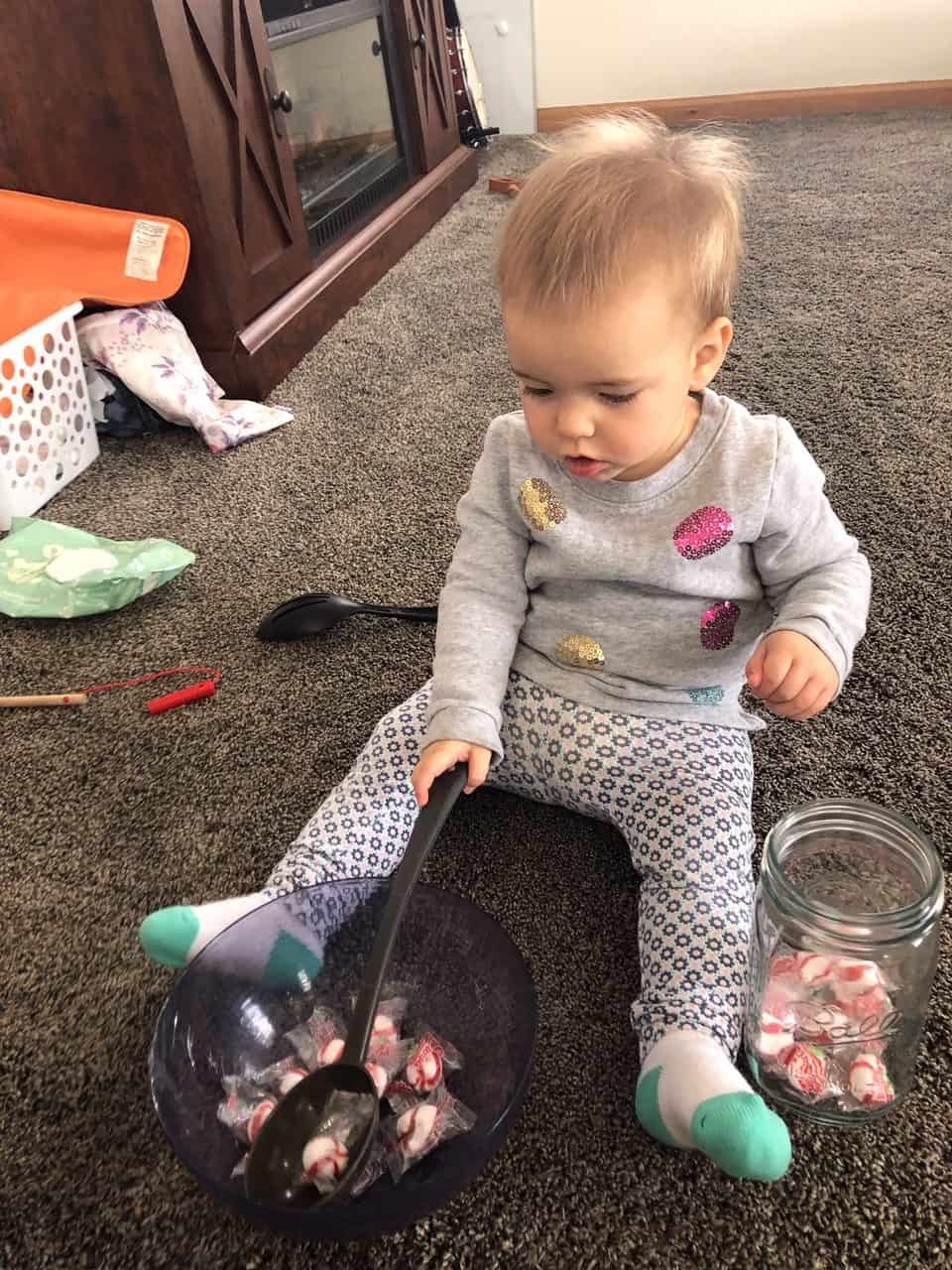
Do you notice how the bowl is centered in front of her face? Placing an object directly in front of her encourages the use of both eyes. Instinctively, my granddaughter practiced using both of her eyes to focus on the large target, the bowl. Then the smaller target, the peppermint. She worked until she figured out how to scoop up a peppermint candy with the ladle. I love her look of concentration in the pictures.
- During play, does your toddler place objects in front of them?
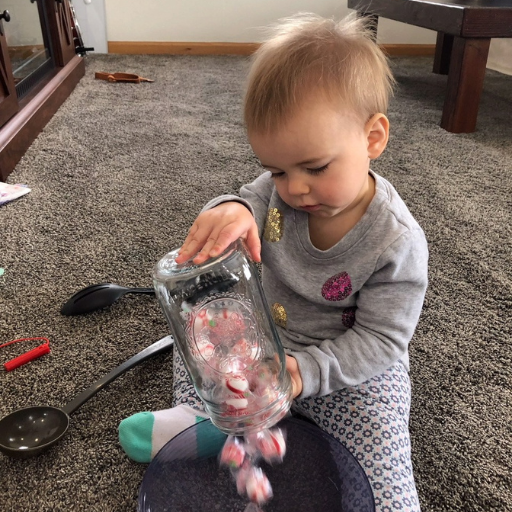
After Shelby filled and dumped the peppermints several more times, she tried something different. I could see her thinking. First, she put the bowl on her right side and the jar between her legs. After five misses, she chose to move the jar back to her left. Eye movement skills in toddlers develop over time with practice. When she is a little older, she will have the motor skills to scoop and fill the jar (a small target) while it is directly in front of her.
Visual Tracking, An Eye Movement Skill in Toddlers
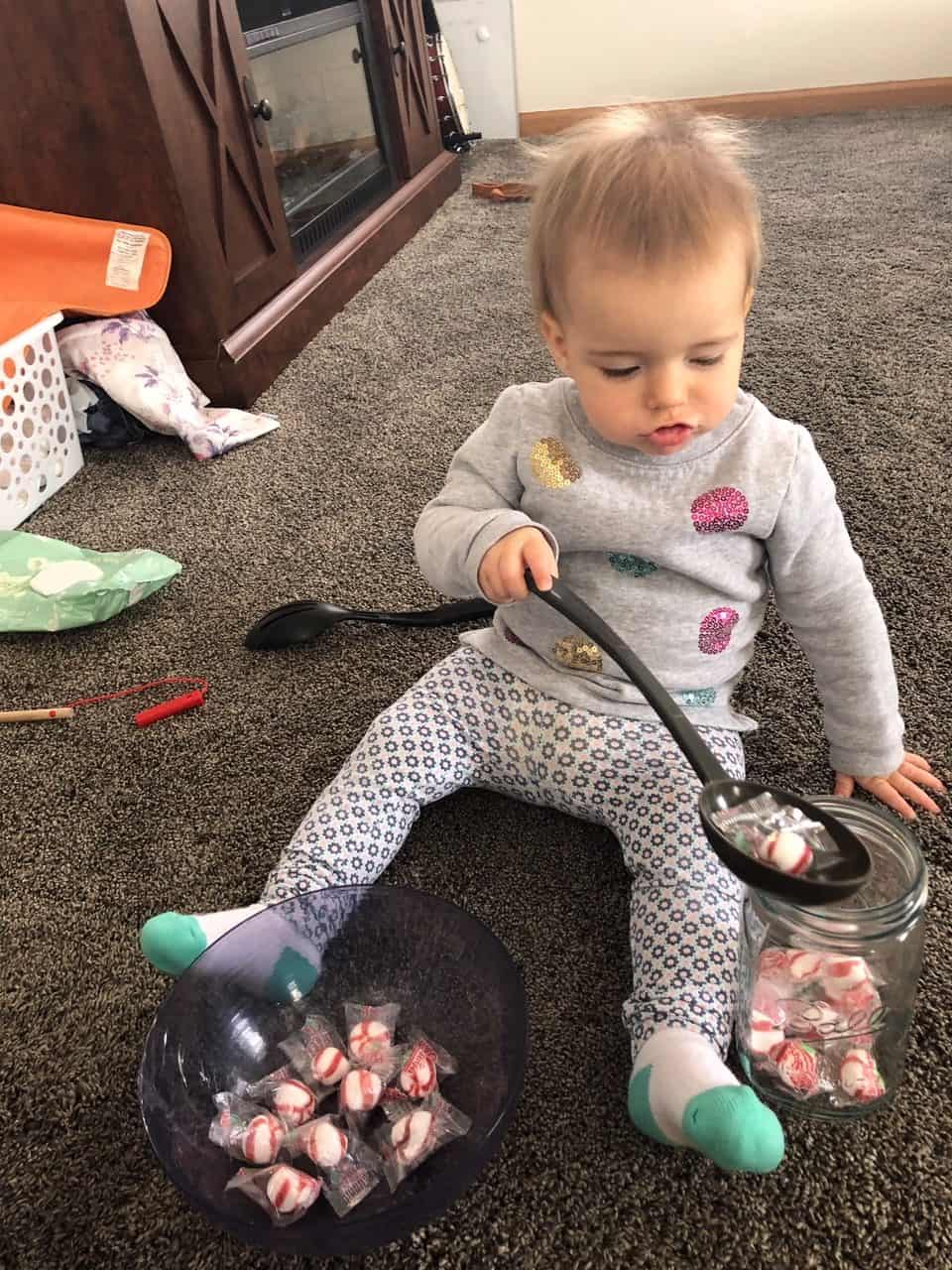
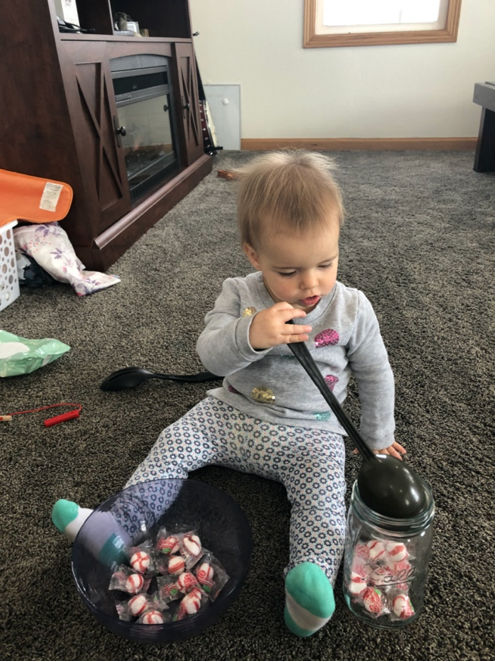
Do you see how Shelby is turning her head and tracking the spoon with both eyes? She is learning to focus on a moving target, which is called visual tracking. Her hand holding the spoon moves from the right side of her visual field, past her face, to the left side of her visual field. Her left hand on the floor helps minimize movement of her body. Thus, her depth perception is more stable. Shelby will one day track an object or read without moving her head.
Just her eyes will move.
Eye Movement Skills in Toddlers: 15 to 18 Months
Your toddler’s eye muscles are continuing to grow stronger and stronger. Their brain continues to learn what to do with what is seen. The eyes are working together to develop eye movement skills in toddlers that keep what is seen clear and single for longer periods of time. Thus, looking at objects far away or up close becomes fun.
- Initiates looking at picture books with simple pictures.
- May say, “look” or “see”.
- When you say the name of an object in a picture, they point to the object.
- Tracks a moving object with more eye movement than head movement.
Activity – Block Play Encourages Eye Teaming
At this stage of development, your toddler’s hand-eye coordination has opened a whole new world to them. They are able to physically control their movements and manipulate toys. Activities such as stacking blocks encourage more than eye-hand coordination. Your toddler is also developing depth perception. In fact, without proper development of depth perception, your toddler will struggle with eye-hand coordination. Depth perception is the ability to perceive the distance between your eyes and an object or the distance between two objects.


Depth perceptional is horizontal, across, and also vertical. To successfully stack blocks, your toddler’s eyes must perceive the distance from their eyes to the block in their hand and the block on the floor. Additionally, your toddler is learning about height, the distance from the block in their hand to the block on the floor. How high must the block be raised to successfully stack it? Between 15 to 18 months of age, your toddler should be able to:
- Push shapes or objects through holes in a container
- Move their eyes to focus on objects near and far
- Move their eyes more than their head to look for objects in front of and beside them
- Become more confident while walking
Activity – Ball Play Encourages Eye-Tracking Movements
Encourage your toddler to push, roll, and throw different objects. You can use beanbags or small stuff animals for throwing when inside. Laundry baskets are a fun addition to the game. If you use a ball, make sure it is small enough for your toddler to easily hold. Sit on the floor across from your toddler and observe their eye movements. If your toddler does not want to sit on the floor and roll a ball to you, have another adult or older child sit behind them.
The second person can help them push the ball so that it rolls to you. You can also create bumpers by touching feet with the second person to help contain the ball. When you roll the ball back to your toddler, watch their eye movements.
- When using the laundry basket, did the object land in the basket most of the time?
- While rolling the ball, did their eyes focus on the ball?
- Whenever the ball came towards your toddler, did she or he reach and grab the ball?
- During ball play did the eyes move to the left and to the right?
Activity – Poke-A-Dot-Books Encourages Focusing on a Target Longer
During my last visit with my granddaughter, I learned about Poke-a-Dot Books. What a wonderful way to encourage your toddler to focus on a target for longer periods of time. Eye Teaming is a visual processing skill. As your toddler looks at pictures in a book or works hard to poke a dot, observe their eyes and their posture.
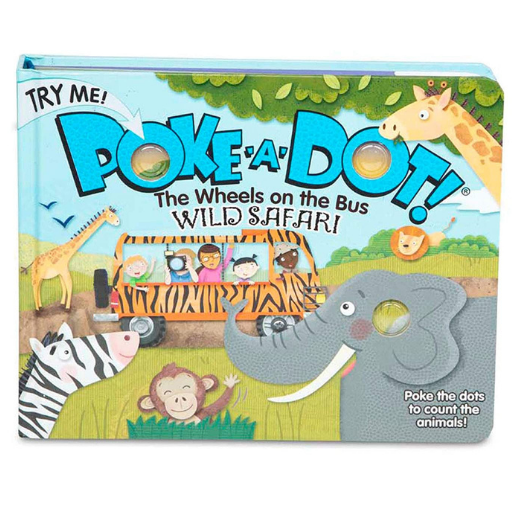
Have your toddler sit up in a chair, couch, or somewhere slightly above the floor. Give them a book. Then, sit on the floor facing your toddler. Try to sit directly in front of them at a height that allows you to more accurately see their eyes. Remember your toddler is developing eye movement skills. Thus, toddlers briefly look at pictures. Occasionally, fatigue may briefly cause pupils within the eyes to look uneven. Turning the page or looking away gives the eye muscles a break.
They only need a few seconds. When they look at the picture again, their eyes should look more even. Eye alignment example pictures are on my auditory-visual training page.
- How is the book held? (At a tilt in front of tummy with spine of book centered on body)
- When focusing on (looking at) a dot or picture, do both eyes turn in and stay in position?
- While looking at book, does the toddler squint?
- In each eye, do pupils look like they are in the same position?
Foundation of Instinctive Movement and Speech
Eye movement skills in toddlers, also called visual processing skills, are the foundation of instinctive movement and speech. When you listen, what you hear must synch up with lip movement. Otherwise, you look away. Thus, a healthy hearing system is just as important as clear, single vision. Toddlers must link what is seen (lip movement, dog) with what is heard (speech, barking) to learn about their world, to respond, and speak. If your toddler shows sound intolerance behaviors like covering their ears or hiding, schedule a free consultation.
Baby or Toddler’s First Eye Exam
Today, it is possible to learn about your baby or toddler’s vision. The American Optometric Foundation recommends an eye exam around nine months of age. Equipment requiring no response from your baby or toddler enables your eye doctor to assess eye movement ability, eye alignment, and their ability to see near and far. You will learn if your little one has astigmatism, amblyopia (lazy eye), or another eye condition known to negatively impact learning.
Since this is your little one’s first exam, you can make an appointment with either an ophthalmologist or an optometrist.
- Ophthalmologists specialize in eye disorders, eye health (prevention of vision loss), and surgeries.
- Optometrists also assess eye health. When concerns are found, optometrists refer patients to an ophthalmologist or to a retina specialist. Most optometrists focus on prescribing glasses.
- Developmental optometrist or neurorehabilitation optometrist, specialize in developmental visual processing skills and vision therapy.
What should you expect? The American WebMD shares helpful information about what to expect at your toddler’s eye exam. Eye exams do not require your little one to verbally respond in order to complete testing. Even when there is excellent eye health and eye alignment, individuals of all ages can still experience other types of visual processing difficulties. Thus, do not ignore your concerns. Schedule an appointment with a pediatric developmental optometrist or pediatric neurorehabilitation optometrist.
It is important to understand that there are numerous different types of visual processing skills. Thus, little ones can display a wide range of behavioral, learning, and emotional difficulties.

Behaviors Indicating Eye Movement Difficulties
- Avoids certain activities (books, coloring, swings, eye contact)
- Walks on toes
- Skips or resist crawling
- Is a late walker
- Difficulty with balance while walking, falls often
- Walks into stationary objects, walls, doors
- Coordination difficulties, seems clumsy
- Dislikes being picked up
- Eyelid droops
- Covers one eye (one eye may look more open)
- Looks with a head tilt or turn
- One eye moves/floats up, down, or to the side
- Pupil is off-centered in one eye
- Sits too close to the TV
- Plays with toys on just the right or left side of their body
- Gets closer and closer to a book or object (can include a person’s face)
- Gets car sick
This post was originally published elsewhere. Read the original post →
Article by
Cheri Moore
Auditory Integration Training (AIT) and ILS Integrated Listening programs are completed in the comfort of your home with the support of Cheri Moore or a practitioner near you. Cheri's online, interactive questionnaires (preschooler, students, adults) with a free phone consultation helps you obtain a report that communicates concern and learn if you can benefit from Cheri's advocacy services.

Disclosure: Autisable.com participates in affiliate programs, including the Amazon Services LLC Associates Program and other affiliate advertising programs. This means we may earn commissions from qualifying purchases at no additional cost to you.
Comments
Join the community to leave a comment.