Autism & Delayed Auditory Processing
This article may contain affiliate links. Learn more
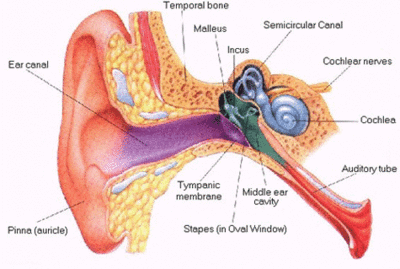
Intriguing research from a hospital in Philadelphia which correlates autism with delayed auditory processing. Sixty-four children ages six to fifteen were subjected to brain wave scans while listening to a series of beeps (probably like your standard hearing test). The researchers found that autistic children responded to the beep more slowly than their neurotypical counterparts, by a small but (apparently) statistically significant fraction of a second. This may be key to explaining autism-related communication deficits - my own son clearly has difficulty parsing complicated instructions and forming words, and despite having perfect hearing often presents as one who is functionally deaf.
From a more practical perspective, if this observation holds true over a larger population, a brain scan may allow for earlier detection of autism. Early detection allows early intervention, the only empirically supported strategy for repairing autism-related deficits. Unfortunately, this sort of thing is the exception rather than the rule in autism research. The precious few autism research dollars available (tens of millions of dollars per year) are typically frittered away on less valuable endeavors.
An inordinate amount of money is spent on clinical trials of folk treatments for autism or debunking various urban myths about autism's roots. There have been at least three large-scale studies in the last few years debunking the "vaccinations made my kid autistic" hysteria - money that could have been spent on research into early detection. Then there's chelation therapy, in which boneheaded parents and doctors feed their autistic kids toilet bowl cleaner or quack-made enzyme tablet to cleanse their bodies of heavy metals. The NIH invested several years into a large-scale clinical trial before realizing how dangerous this sort of stuff can be to children. More money that could have been spent on early detection research.
There is also a fair amount of money dedicated to researching the genetic underpinnings of autism. I'm not opposed to this research in principle but I'm not sure what it actually tells us. Most of these studies involve number-crunching existing databases looking for correlations between fragments of genetic material and reported autism. Wikipedia lists a dozen reports correlating autism to deletion at xyz or insertion at abc but we frankly don't understand enough about which genes do what to glean any valuable insight into treatment or therapy. In the near term, the only likely outcome of genetic research is the creation of methods for prenatal autism screening. Giving us the ability to "cure" autism in the same inhuman way that we've "cured" Down syndrome. Data-mining is cheap and easy research and ought to be continued, but it's not going to help Elvis pay attention in school. At least not with what we know now.
Bottom line is that early detection and intervention as per current science provide the best possible outcome. Early intervention has given Elvis several hundred words, consistent eye contact, and functional communication. As a kindergartener he counts to twenty, recites his alphabet and writes his name. In some areas he's still way off the chart, especially in terms of social skills and communication, but he's headed the right direction. He acknowledges peers and siblings, takes turn, and shares (sometimes). Not because we changed his diet or fed him enzyme pills, but because we followed the science.


Disclosure: Autisable.com participates in affiliate programs, including the Amazon Services LLC Associates Program and other affiliate advertising programs. This means we may earn commissions from qualifying purchases at no additional cost to you.
Comments
Join the community to leave a comment.