A Substitute Teacher Plan That Autistic Students Can Trust

This article may contain affiliate links. Learn more
The sub plan on your desk covers the lesson. Page 74, the worksheet packet, where the pencils live. For most of your class, that is plenty. For the autistic student in row two, the lesson was never the fragile part. You were. A substitute teacher plan that works for that student has to account for the fact that the most important thing changing today is not the content. It is the person.
Unpredictability is an anxiety problem, not a preference
It is tempting to read a hard sub day as a student being inflexible. The research points somewhere more sympathetic. A meta-analysis in Autism pooling 12 studies and 656 participants found intolerance of uncertainty and anxiety are tightly linked in autistic people, with uncertainty accounting for roughly 38 percent of the variance in anxiety. An unfamiliar adult running an unfamiliar version of the day is not a minor inconvenience. An unfamiliar adult is a genuine anxiety load, layered on top of a school day that already costs more than it looks like it costs.
Sub days are not rare anymore either. Analysis of state records in four states found teacher absences running 20 to 50 percent above pre-pandemic levels (Brookings, 2024).
One honest caveat: no published study has tested whether leaving a written profile for a substitute reduces problem behavior in autistic students. That study does not exist. What the research supports is the chain underneath it, and the plan below is that chain applied to the day you are out.

What to leave in the substitute teacher plan
Write a half-page profile, not a novel. What calms this student, what escalates them, their early warning signs, and who to call.
Name the non-negotiable routines. If the visual schedule gets reviewed at 8:05 every morning, say so. Skipping it is the change that costs the most.
Start with easy wins. Running two to five requests the student reliably says yes to before a demanding one substantially increases compliance, confirmed at Tau-U of .87 in a meta-analysis of single-case research.


Prime the change in advance. A small study of three children found previewing a transition reduced disruptive behavior, with gains carrying to transitions never previewed. A photo of the sub on the schedule is the classroom version.
Keep the visual schedule running. The student should be able to check what is next without asking a stranger.
The structure should outlast the staffing
The day should belong to the student, not to whichever adult is at the front. When the schedule is visual and familiar, a new face becomes one change instead of every change at once. Our guide to visual schedules in the classroom goes further.
VizyPlan was built by an autism dad and a licensed speech-language pathologist so the same visual routine a student relies on at school keeps running at home, using photos of the real child.
Share VizyPlan with your families so predictable structure follows the student home. The 7-day free trial lets a family try it first. Just $6.99/month after, no credit card required upfront.
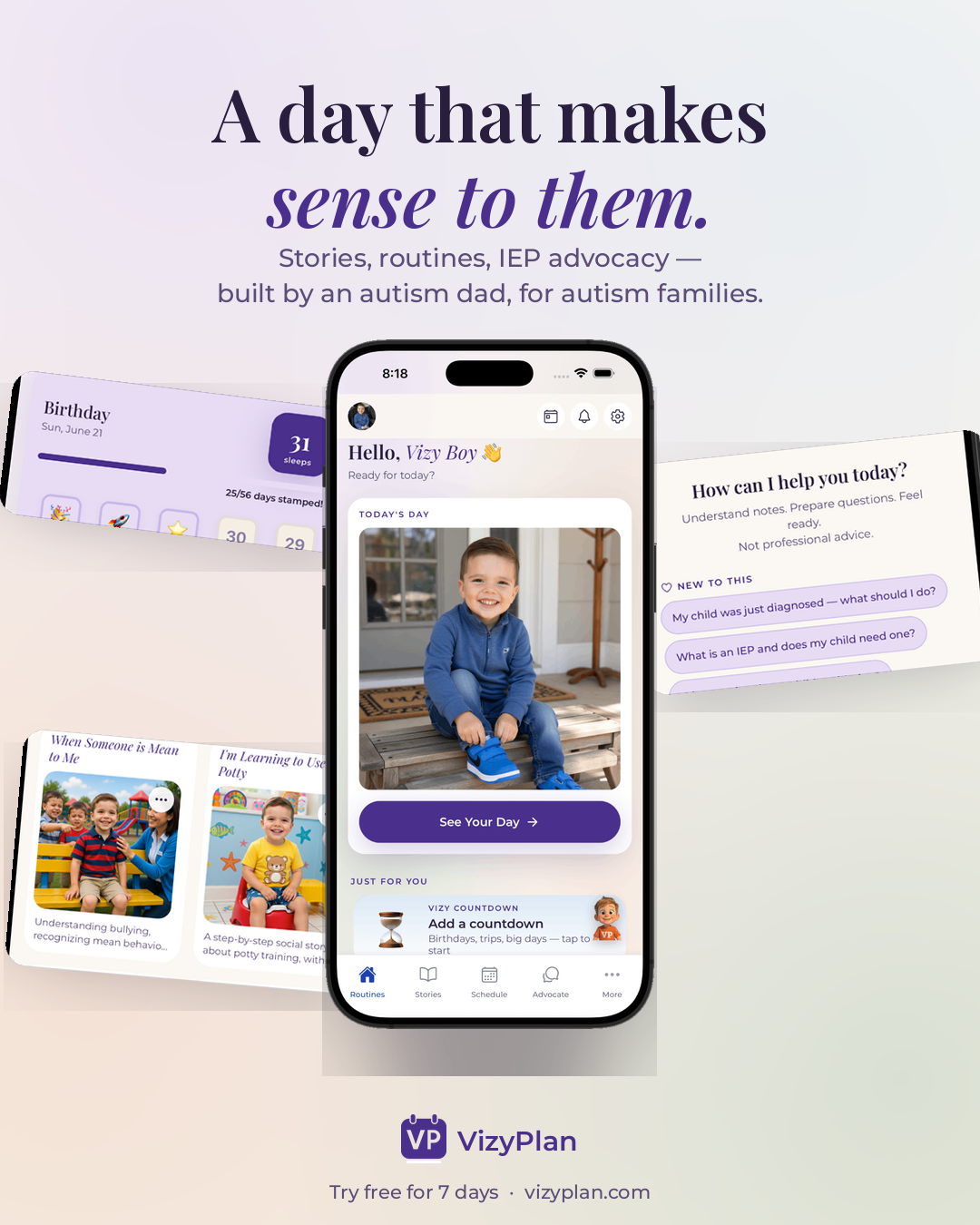
VizyPlan was built by an autism dad and a licensed speech-language pathologist who needed something that did not exist. Explore VizyPlan.
This post was originally published elsewhere. Read the original post →

Article by
Justin Bowman
VizyPlan was created by a father who was frustrated by scattered tools and systems that added stress instead of reducing it. He built what his family needed: a simple way to help his family navigate each day with confidence. For more information, check out https://vizyplan.com

Disclosure: Autisable.com participates in affiliate programs, including the Amazon Services LLC Associates Program and other affiliate advertising programs. This means we may earn commissions from qualifying purchases at no additional cost to you.
Comments
Join the community to leave a comment.